Enterprise AI Governance Explained: The Definitive Guide for Security and Risk Leaders
Introduction
Sometime in the last two years, a quiet shift happened inside almost every large organization. Employees stopped asking whether they were allowed to use AI and simply started using it. A financial analyst pastes a draft earnings model into ChatGPT to clean up the formatting. A developer asks Copilot to refactor a function that happens to contain an internal API key. A recruiter uploads a stack of résumés to Gemini. None of these people think of themselves as a security risk; each is just trying to get work done faster.
That is the reality enterprise security and risk leaders now have to manage. Generative AI did not arrive through a controlled procurement process with a vendor assessment and a data processing agreement. It arrived through the browser, on personal accounts, one helpful prompt at a time — and brought a governance problem that does not fit neatly into any existing control framework.
AI governance is the discipline that answers this problem. It is how an enterprise sets the rules for how AI may be used, enforces them consistently, proves to regulators and auditors that they are working, and does all of this without becoming the department that says no to everything. This guide explains what enterprise AI governance actually is, why it has become a board-level concern, how it works in practice, and what a defensible architecture looks like — written for the people who have to make these decisions and assuming you are less interested in hype than in something you can implement.
Why This Matters
The urgency here is not theoretical. Three forces are converging and reinforcing each other.
The first is adoption velocity. Generative AI reached enterprise saturation faster than cloud, faster than mobile, and far faster than any governance program designed to manage it. Most security teams discovered AI was already in heavy use only after they went looking for it — the gap between usage and oversight is wider than for any prior technology wave.
The second is data sensitivity. Unlike most SaaS tools, generative AI invites users to hand over exactly the content security teams spend their careers protecting. People paste source code, customer records, contracts, board materials, and financial projections into a prompt because the AI is genuinely useful when given real context. The very behavior that makes AI valuable is the behavior that makes it dangerous.
The third is regulatory pressure. The EU AI Act is now in force, with obligations phasing in through 2026 and 2027; prohibited practices have been enforceable since February 2025 and general-purpose AI model obligations since August 2025. Frameworks like the NIST AI Risk Management Framework and the certifiable ISO/IEC 42001 standard have moved from interesting reading to line items in procurement questionnaires, and customers now ask vendors how they govern AI before they sign.
Put these together and the conclusion is simple. AI usage is not slowing down, the data exposure is real, and the accountability is landing on named executives. Governance is the control layer that determines whether your organization adopts AI confidently or keeps pretending it is not happening.
Definition: What Is AI Governance?
AI governance is the set of policies, processes, controls, and technologies an organization uses to manage how artificial intelligence is developed, procured, deployed, and used — so that AI delivers value while staying within the organization's risk tolerance, legal obligations, and ethical commitments.
It helps to separate two things that often get blurred: governance of AI the organization builds — models trained in-house, fine-tuned systems, automated decisions that affect customers — and governance of AI the organization consumes — employees using third-party tools like ChatGPT, Microsoft Copilot, Google Gemini, and Claude in the course of their work. Both matter, but for most enterprises in 2026 the consumption side is the more immediate and least controlled problem, because it spreads through ordinary daily work rather than formal projects.
Enterprise AI governance, then, is the operational layer that gives leadership visibility into who is using which AI systems for what purpose, the ability to enforce policy on those interactions in real time, and the audit trail to prove it. It overlaps with data governance, security operations, privacy, and model risk management, but its distinguishing feature is that it treats the AI interaction itself — the prompt, the file upload, the model response — as the unit of control.
A useful mental model is three layers that build on one another: visibility (knowing what is happening), policy (deciding what should be allowed), and enforcement (making the policy real at the moment of use). Programs that stop at visibility produce dashboards no one acts on; programs that jump to enforcement without visibility block the wrong things. The discipline is getting all three working together.
Why Enterprises Care
For a CISO, the appeal is straightforward: governance closes a blind spot that sits outside every existing control. DLP tools were built for email and endpoints, not for a text box in a browser that sends content to a third party. Cloud access security brokers were built to govern sanctioned SaaS, not the long tail of AI features now embedded in every productivity app. Governance fills the space between them.
For a CIO, the calculus is enablement. The business wants the productivity gains AI offers, and the CIO who blocks AI outright simply pushes usage onto personal devices where the organization has zero visibility. Governance is what lets a CIO say yes while keeping AI inside guardrails the board will accept.
For compliance and risk leaders, the driver is provability. It is no longer enough to have a policy stating employees should not share confidential data with AI tools — auditors and regulators want evidence that it is enforced and violations are handled, and governance produces that evidence as a byproduct of operating. Increasingly it is also a sales prerequisite: enterprise buyers now include AI governance questions in vendor due diligence, and a company that can point to ISO/IEC 42001 alignment and an audit trail has an easier path through procurement than one that shrugs.
How It Works
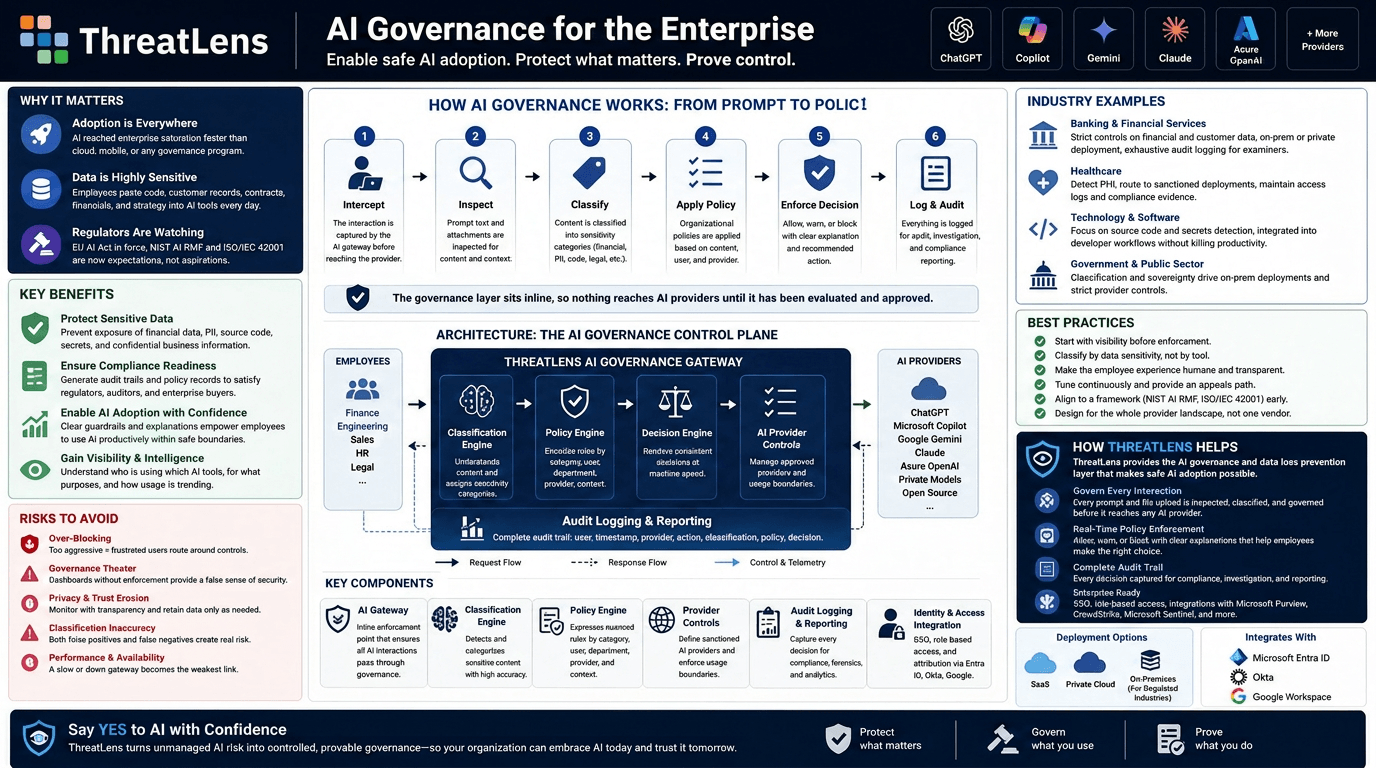
The mechanics become much clearer once you follow a single interaction from start to finish. Imagine an employee in finance typing a prompt into an approved AI workspace: "Analyze our Q4 revenue and forecast next quarter." Here is what a working governance system does with it.
First, it intercepts the interaction before it reaches the provider. This is the architectural heart of the model — the governance layer sits inline, so nothing is sent to OpenAI, Microsoft, Google, or Anthropic until it has been evaluated. This is why the pattern is described as an AI gateway.
Second, it inspects the content. The prompt text and any attached files are examined to understand what they contain — "Q4 revenue and forecast" signals financial information, and a file upload would be parsed the same way, looking for patterns that indicate source code, personal data, credentials, or confidential business material.
Third, it classifies the content into a sensitivity category — financial, customer, source code and secrets, HR, legal, strategic and board-confidential, public, or unknown. Classification turns raw text into something policy can reason about.
Fourth, it applies policy. The organization has decided in advance what happens to each category in each context. Financial data heading to an unapproved consumer account might be blocked outright; the same data heading to a sanctioned enterprise deployment with a data processing agreement in place might be allowed, or allowed with sensitive values redacted. Policy is where the organization's risk tolerance gets encoded into rules.
Fifth, it makes and enforces a decision — allow, redact, route, or block — and returns it to the user with an explanation, so the employee sees why an action was flagged and can adjust rather than simply feeling thwarted. Sixth, it logs everything: user, timestamp, provider, action, classification, policy triggered, and decision — the audit trail compliance and security teams rely on, generated automatically rather than reconstructed after an incident.
The entire sequence happens in the time a normal AI request takes to complete, which is the point. Governance that adds noticeable friction trains people to avoid it; governance that is nearly invisible until it needs to act is governance people will actually work inside.
Key Components
A complete enterprise AI governance capability is built from several distinct components, each doing a specific job.
The AI gateway is the inline enforcement point that ensures interactions actually pass through governance rather than around it. Without it, every other component is advisory at best, because policy that cannot be enforced at the moment of use is just documentation.
The classification engine is the system's understanding of content — it reads prompts and files and assigns sensitivity categories. Its quality largely determines the quality of the whole program: too aggressive and it blocks harmless work, too permissive and sensitive data slips through. Mature engines combine pattern matching for well-structured data like credit card numbers and API keys with contextual analysis for messier categories like strategic plans or legal language.
The policy engine is where the organization's rules live and where policy enforcement is defined. Good ones express nuance — this category, from this department, to this provider, in this context, gets this treatment — where crude ones offer only a global allow or block that never survives contact with real business needs. The decision engine turns classification and policy into an outcome — allow, redact, route, or block — consistently and fast.
AI provider controls let the organization decide which AI systems are sanctioned. An enterprise might approve its licensed Copilot and a private Azure OpenAI deployment while redacting sensitive data sent to consumer ChatGPT and blocking unknown AI services entirely — this is how shadow AI gets brought into the light.
Audit logging and reporting is the evidence layer, capturing every decision in a form that supports investigation, compliance reporting, and trend analysis. And identity and access integration ties governance to who people are: by connecting to the organization's identity provider — Microsoft Entra ID, Okta, Google Workspace — policy can vary by role and department, and every action is attributable to a real, authenticated person.
Benefits
The clearest benefit of a working AI governance program is that it replaces a binary, losing choice with a manageable one: it lets leadership say yes to AI while retaining control, which is the only sustainable answer to a technology employees will use regardless.
Data protection is the most concrete benefit. Sensitive data exposure is prevented at the point it would occur, before content leaves the organization's boundary. Source code with embedded secrets, customer PII, financial projections, and confidential legal material are caught in the prompt rather than discovered in a breach report months later.
Compliance readiness follows naturally. Because governance produces audit logs and policy records as a matter of routine, the organization can demonstrate control to regulators and auditors without scrambling. Alignment with the NIST AI RMF and ISO/IEC 42001 becomes something you can show rather than something you hope is true, and for organizations facing the EU AI Act, documented governance over AI usage is part of the foundation for broader compliance.
There is also a productivity benefit that is easy to overlook. When employees know an approved AI workspace exists and will tell them clearly when something is off-limits, they stop self-censoring out of vague fear and use AI confidently within known boundaries. Clear rules, consistently enforced and explained, are more enabling than no rules at all. Governance also gives leadership genuine visibility into adoption — which teams use AI, for what, and how that is trending — intelligence that informs licensing, training, and where to invest next.
Risks
It would be dishonest to present AI governance as pure upside, so let us be clear about where programs go wrong.
The most common failure is over-blocking. A program tuned too aggressively becomes the thing employees resent and evade. If the classification engine flags ordinary work as sensitive, or the policy engine blocks legitimate use cases, people find the path of least resistance — usually their personal phone — and the organization ends up with worse visibility than before it started.
The opposite failure is governance theater: a program that produces dashboards but does not enforce anything at the moment of use. Visibility without enforcement feels like progress and provides almost none — the AI-era equivalent of a security policy that exists only as a PDF nobody reads.
There is also a genuine privacy tension. Inspecting employee prompts means the system sees what employees are doing, and that has to be handled carefully. Programs that monitor without transparency, or retain prompt content longer than necessary, can damage trust and run into employment and privacy law, particularly in jurisdictions with strong worker protections.
Classification accuracy is an ongoing risk. No engine is perfect — false positives create friction, false negatives let sensitive data through. A program needs a process for tuning, an appeals path, and human review for ambiguous cases; treating classification as a fire-and-forget setting is a mistake.
Finally, the gateway itself can become a single point of failure or a performance bottleneck. If inline governance goes down or slows to a crawl, it either blocks all AI usage or gets bypassed in a hurry. Resilience and performance are not nice-to-haves here; they are conditions of the model working at all.
Common Misconceptions
A few persistent misunderstandings make AI governance harder than it needs to be.
The first is that AI governance means blocking AI. This is exactly backwards. The premise of modern governance is to enable AI adoption safely — the goal is the safe yes, not the reflexive no. Organizations that frame governance as restriction tend to build programs nobody wants.
The second is that existing DLP already covers this. Traditional data loss prevention was built for email, file transfers, and endpoints. It generally does not understand the conversational, browser-based nature of AI interactions, and has no concept of which provider is receiving the data or whether it is sanctioned. AI governance is adjacent to DLP and ideally integrates with it, but it is not the same control.
The third is that a policy document is governance. Writing "do not share confidential data with AI tools" in an acceptable use policy is necessary but nowhere near sufficient. Policy without enforcement is a hope, not a control; governance is what makes the policy operative at the moment a person tries to do the thing it forbids.
The fourth is that this is only a problem for AI the company builds. Model risk management teams have governed in-house models for years, but the more widespread and less controlled exposure today comes from employees using third-party AI tools — the surface traditional model governance does not cover.
The fifth is that one provider's native controls are enough. Microsoft's governance features for Copilot are useful, but enterprises do not use only one provider. People use ChatGPT, Gemini, Claude, and a growing list of embedded AI features simultaneously, and governance that covers one vendor leaves the rest uncontrolled.
Enterprise Architecture
Architecturally, an AI governance platform is best understood as a control plane in the path between people and AI providers. The flow is linear: the employee initiates an interaction, it reaches the governance gateway, the gateway passes it through classification and policy engines, the decision engine renders a verdict, and only then — if the verdict allows — does the request continue to the provider.
There are a few ways to realize this pattern. Some deployments put governance in the browser through an extension or managed browser; some operate as a network or API proxy that AI traffic is routed through; some provide a dedicated AI workspace with governance built in. Many mature programs combine approaches, because employees reach AI through many paths and no single interception point catches all of them.
Three integration surfaces matter most. The first is identity — connecting to Entra ID, Okta, or Google Workspace through SSO so policy is role-aware and every action attributable. The second is the existing security ecosystem — coordinating with DLP and CASB and surfacing AI events alongside the rest of the security picture rather than in a silo. The third is the AI providers themselves — governing access to OpenAI, Azure OpenAI, Anthropic, Google, and private or open-source deployments through a consistent policy layer.
Deployment model is its own decision, driven largely by data sensitivity and regulation. SaaS is the fastest path; private cloud suits stricter data residency needs; and on-premises is what regulated industries — banking, government, critical infrastructure — often require, because the governance layer inspects the most sensitive content and that inspection cannot leave the building. A well-designed platform supports all three from the same core, so the choice is about deployment, not a different product.
Best Practices
The organizations that get AI governance right tend to share a set of habits.
Start with visibility before enforcement. Before you block anything, understand what is actually happening — run the program in monitoring mode first, learn which teams use which tools for what, and let that reality shape your policy. Policy written in the abstract, before you have seen real usage, is almost always wrong in ways that generate friction.
Classify by sensitivity, not by tool. What matters is the data in the interaction, not merely which service it is going to. A harmless public question to ChatGPT and a confidential financial model to the same service deserve completely different treatment. Build policy around content sensitivity and use provider controls as a second dimension.
Make the employee experience humane. Every block and redaction should come with a clear, specific explanation of why and, ideally, what the person can do instead. The difference between a program people accept and one they resent is almost entirely in how it communicates at the moment of friction. Pair this with transparency about monitoring — tell employees what is inspected, why, and how long records are kept, because covert monitoring breeds the distrust that leads people to route around the system.
Tune continuously and provide an appeals path. Classification will sometimes be wrong, so build the feedback loop in from the start — a way to flag false positives, a review process for ambiguous cases, and a regular cadence of tuning. A governance program is a living system, not a one-time configuration.
Align to a recognized framework early. Mapping to the NIST AI RMF or working toward ISO/IEC 42001 from the beginning gives you a structure to build against and an artifact to show customers and regulators later — far easier than retrofitting it onto a program that grew organically. And design for the whole provider landscape, not one vendor: enterprise users rely on multiple AI tools, and the list grows every quarter.
Industry Examples
The shape of an AI governance program changes with the industry.
In banking and financial services, the dominant concern is regulated data and the auditability of every interaction. Traders, analysts, and relationship managers handle material non-public information, customer financial records, and confidential deal material daily, and the temptation to use AI on it is enormous. Governance here leans toward strict policy on financial and customer data, on-premises or private deployment to keep inspection inside the regulatory boundary, and exhaustive audit logging because examiners will ask. The cost of a single inadvertent disclosure of MNPI through a consumer AI tool dwarfs the cost of the program.
In healthcare, protected health information drives everything. Clinicians find AI useful for drafting notes and summarizing records, but PHI flowing to an unsanctioned AI service is a reportable breach. Governance focuses on detecting health and personal data, channeling usage toward sanctioned deployments covered by appropriate agreements, and maintaining the access logs compliance requires.
In technology and software companies, the crown jewel is source code, and the most common near-miss is a developer pasting proprietary code — sometimes with embedded credentials — into an AI assistant. Governance is tuned heavily toward source code and secrets detection, often integrated into developer tools, and balanced so it does not strangle the productivity that makes AI coding assistants valuable.
In government and the public sector, classification and sovereignty dominate. Classified or citizen data cannot leave controlled environments, pushing governance toward on-premises deployment and strict provider controls, frequently limiting usage to approved internal or sovereign deployments only. Across all of these, the organizations that succeed treat governance as an enabler of AI adoption rather than a brake on it.
Frequently Asked Questions
What is AI governance in simple terms?
It is how an organization sets and enforces the rules for how AI is used, so employees can benefit from AI tools without exposing sensitive data, violating regulations, or creating unacceptable risk. In practice it means visibility into AI usage, policies about what is allowed, and a way to enforce those policies at the moment AI is used.
What is AI DLP, and how is it different from traditional DLP?
AI DLP, or AI data loss prevention, inspects prompts and file uploads before they reach an AI provider and redacts, routes, or blocks them when they contain sensitive data. Traditional DLP was built for email, endpoints, and file transfers. AI DLP is purpose-built for the conversational, browser-based nature of AI interactions and understands which provider is receiving the data — something traditional DLP generally does not.
What is AI security?
AI security is the broader discipline of protecting AI systems and protecting the organization from AI-related risk — securing models against attacks like prompt injection and data poisoning, securing the infrastructure AI runs on, and preventing data exposure through AI usage. AI governance is the part of AI security focused on managing and controlling how AI is used.
What is shadow AI?
Shadow AI is the use of AI tools the organization has not sanctioned or does not know about — personal ChatGPT accounts, unapproved browser extensions, or AI features embedded in other apps. It is the AI equivalent of shadow IT, and the single largest source of ungoverned AI risk in most enterprises today.
What is an AI gateway?
An AI gateway is the inline control point that AI interactions pass through before reaching a provider. Like a network gateway, it is a chokepoint where the organization can inspect content, apply policy, and enforce decisions. It is the architectural foundation of real-time governance, because policy that cannot be enforced at the point of use is only advisory.
Does AI governance mean we have to block ChatGPT and Copilot?
No. The goal is to enable safe AI adoption, not ban AI. Most programs allow approved tools, apply redaction or blocking only to genuinely sensitive interactions, and steer usage toward sanctioned deployments. Blocking everything backfires by pushing usage onto personal devices where the organization has no visibility at all.
Which regulations require AI governance?
The EU AI Act is the most prominent, with obligations phasing in through 2026 and 2027 and prohibited practices and general-purpose AI rules already enforceable. Sector regulations in finance, healthcare, and government increasingly expect documented AI oversight, and frameworks like the NIST AI RMF and ISO/IEC 42001 have become de facto expectations in enterprise procurement even where they are not legally mandated.
How do we start an AI governance program?
Begin with visibility. Deploy in a monitoring posture, learn what AI usage actually looks like, and let that reality shape your policy. Map to a framework like the NIST AI RMF from the start, involve security, IT, legal, and the business together, and roll out enforcement gradually rather than all at once.
Is on-premises AI governance necessary, or is SaaS enough?
It depends on your data sensitivity and regulatory environment. SaaS is faster and suits many organizations. Regulated industries handling classified, health, or financial data often require private cloud or on-premises deployment so the governance layer — which by design inspects the most sensitive content — keeps that inspection inside their own boundary.
How does AI governance support compliance audits?
It generates audit logs as a routine part of operating — recording user, timestamp, provider, action, classification, policy triggered, and decision. That continuous record is exactly what auditors and regulators ask for, letting the organization demonstrate control on demand rather than reconstructing evidence after an incident.
Key Takeaways
AI governance is the discipline of setting, enforcing, and proving the rules for how AI is used across an enterprise — covering both the AI an organization builds and the third-party AI its employees consume. For most organizations the consumption side is the more urgent problem, because it spreads through everyday work rather than formal projects.
It matters now because of a collision of three forces: AI adoption that outpaced every prior technology wave, the sensitivity of the data employees willingly hand to AI tools, and a regulatory environment that has moved from guidance to enforcement.
Mechanically, governance intercepts AI interactions through a gateway, inspects and classifies their content, applies policy, enforces a decision, and logs everything — a control plane between people and AI providers, deployable as SaaS, private cloud, or on-premises depending on data sensitivity.
The programs that succeed start with visibility before enforcement, classify by data sensitivity rather than by tool, treat the employee experience as a first-class concern, tune continuously, stay transparent about monitoring, and align to a recognized framework early. The ones that fail either over-block until employees route around them or produce dashboards that enforce nothing. The whole point is the safe yes — enabling AI adoption rather than banning it.
Conclusion
For most of the history of enterprise security, the hard part was keeping unauthorized people and software out. AI inverts the problem. The risk is not an intruder; it is your own employees, doing their jobs, using genuinely helpful tools, and handing those tools exactly the data you most need to protect. You cannot solve that by saying no, because no does not stop the behavior — it only stops you from seeing it.
AI governance is the discipline that lets an organization embrace AI with its eyes open. It turns an unmanaged, invisible risk into a controlled and provable one — giving security leaders a control where they had a blind spot, CIOs a way to say yes without losing the board's confidence, and compliance teams the evidence to satisfy regulators and customers. Done poorly, it becomes friction employees evade; done well, it becomes the quiet infrastructure that makes safe AI adoption possible.
The organizations that adopt AI most confidently over the next few years will not be the ones with the strictest bans or the loosest free-for-alls. They will be the ones that built governance into how AI is used from the start, so the safe path and the productive path are the same path. The time to start is before the next employee pastes the next confidential document into the next AI tool — which, somewhere in your organization, is probably happening right now.
How ThreatLens Helps
ThreatLens provides the AI governance and data loss prevention layer described throughout this guide. It sits between your employees and AI providers — ChatGPT, Microsoft Copilot, Google Gemini, Claude, Azure OpenAI, and private or open-source model deployments — and governs every prompt and file upload before it reaches the provider.
Each interaction passes through the ThreatLens gateway, where a classification engine identifies sensitive content across categories such as financial data, customer PII, source code and secrets, HR records, legal material, and strategic or board-confidential information. Policy is applied in real time, and the interaction is allowed, redacted, routed to an approved model, or blocked — always with a clear explanation to the employee, so governance enables work rather than obstructing it. Every decision is recorded in a complete audit trail capturing the user, timestamp, provider, action, classification, and policy triggered.
ThreatLens is built for enterprise reality. It governs multiple AI providers through a single policy layer rather than one vendor's native controls, integrates with identity systems such as Microsoft Entra ID, Okta, and Google Workspace through SSO and role-based access control, and is designed to fit alongside existing security investments like Microsoft Purview, CrowdStrike, and Microsoft Sentinel. It deploys as SaaS, in your private cloud, or fully on-premises for regulated industries where inspection of sensitive content cannot leave your environment.
The guiding principle is the one this guide has argued for throughout: secure AI adoption without slowing the business. ThreatLens exists to help organizations say yes to AI confidently — with the visibility, governance, and proof that turn an unmanaged risk into a controlled one.