What Is AI Governance? A Plain-Language Guide for Business and Tech Leaders
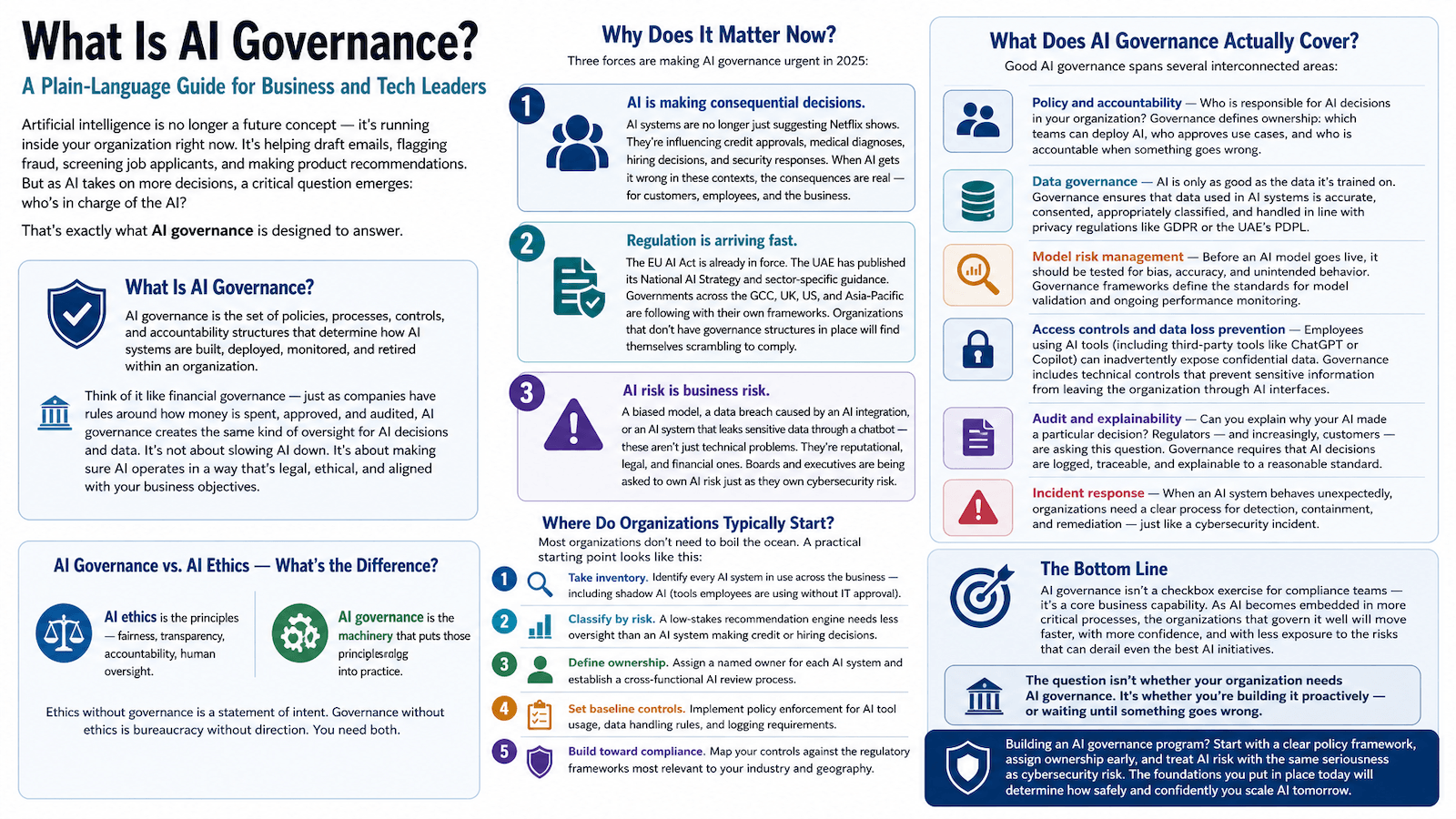
Your organization is already running AI — screening candidates, flagging fraud, drafting customer replies, shaping security responses. But here's the question most leaders can't answer: who's actually in charge of the AI? That question is what AI governance exists to solve.
Artificial intelligence is no longer a future concept. It's making consequential decisions inside your business today. And as AI takes on more of those decisions, the organizations that control it deliberately will outperform the ones that don't — while avoiding the legal, ethical, and reputational landmines along the way.
What is AI governance?
AI governance is the set of policies, processes, controls, and accountability structures that determine how AI systems are built, deployed, monitored, and retired within an organization.
Think of it like financial governance. Just as companies have rules for how money is spent, approved, and audited, AI governance creates the same oversight for AI decisions and the data behind them. It isn't about slowing AI down — it's about making sure AI operates legally, ethically, and in line with your business objectives.
Why AI governance matters now
Three forces are making this urgent in 2025:
AI is making high-stakes decisions. AI no longer just suggests what to watch next. It influences credit approvals, medical guidance, hiring, and security actions. When it gets those wrong, the consequences are real.
Regulation is arriving fast. The EU AI Act is already in force. The UAE, UK, US, and Asia-Pacific are rolling out their own frameworks. Organizations without governance structures will be scrambling to comply.
AI risk is business risk. A biased model, a chatbot leaking sensitive data, or an AI integration that triggers a breach — these aren't just technical problems. They're financial, legal, and reputational ones that land on the board's desk.
What AI governance actually covers
Strong AI governance spans several connected areas:
Policy and accountability — Who owns AI decisions? Governance defines which teams can deploy AI, who approves use cases, and who's accountable when something goes wrong.
Data governance — AI is only as good as its data. Governance ensures the data feeding your AI is accurate, consented, classified, and handled in line with privacy law.
Model risk management — Before a model goes live, it should be tested for bias, accuracy, and unintended behavior — then monitored continuously.
Access controls and data loss prevention — Employees using AI tools can unintentionally expose confidential data. Governance adds technical controls that stop sensitive information from leaking through AI interfaces.
Audit and explainability — Can you explain why your AI made a decision? Regulators and customers increasingly expect AI decisions to be logged, traceable, and explainable.
Incident response — When AI behaves unexpectedly, you need a clear process to detect, contain, and remediate — just like a security incident.
AI governance vs. AI ethics — what's the difference?
These terms get used interchangeably, but they're not the same. AI ethics is the principles — fairness, transparency, human oversight. AI governance is the machinery that puts those principles into practice. Ethics without governance is a statement of intent. Governance without ethics is bureaucracy without direction. You need both.
Where organizations should start
You don't need to boil the ocean. A practical starting point:
- Take inventory — Identify every AI system in use, including shadow AI tools employees adopted without approval.
- Classify by risk — A recommendation engine needs less oversight than an AI making hiring or credit decisions.
- Define ownership — Assign a named owner per system and set up a cross-functional review process.
- Set baseline controls — Enforce policy on AI tool usage, data handling, and logging.
- Build toward compliance — Map your controls to the regulations relevant to your industry and region.
The bottom line
AI governance isn't a compliance checkbox — it's a core business capability. As AI becomes embedded in critical processes, the organizations that govern it well will move faster, with more confidence and less exposure.
The question isn't whether your organization needs AI governance. It's whether you're building it proactively — or waiting until something goes wrong.