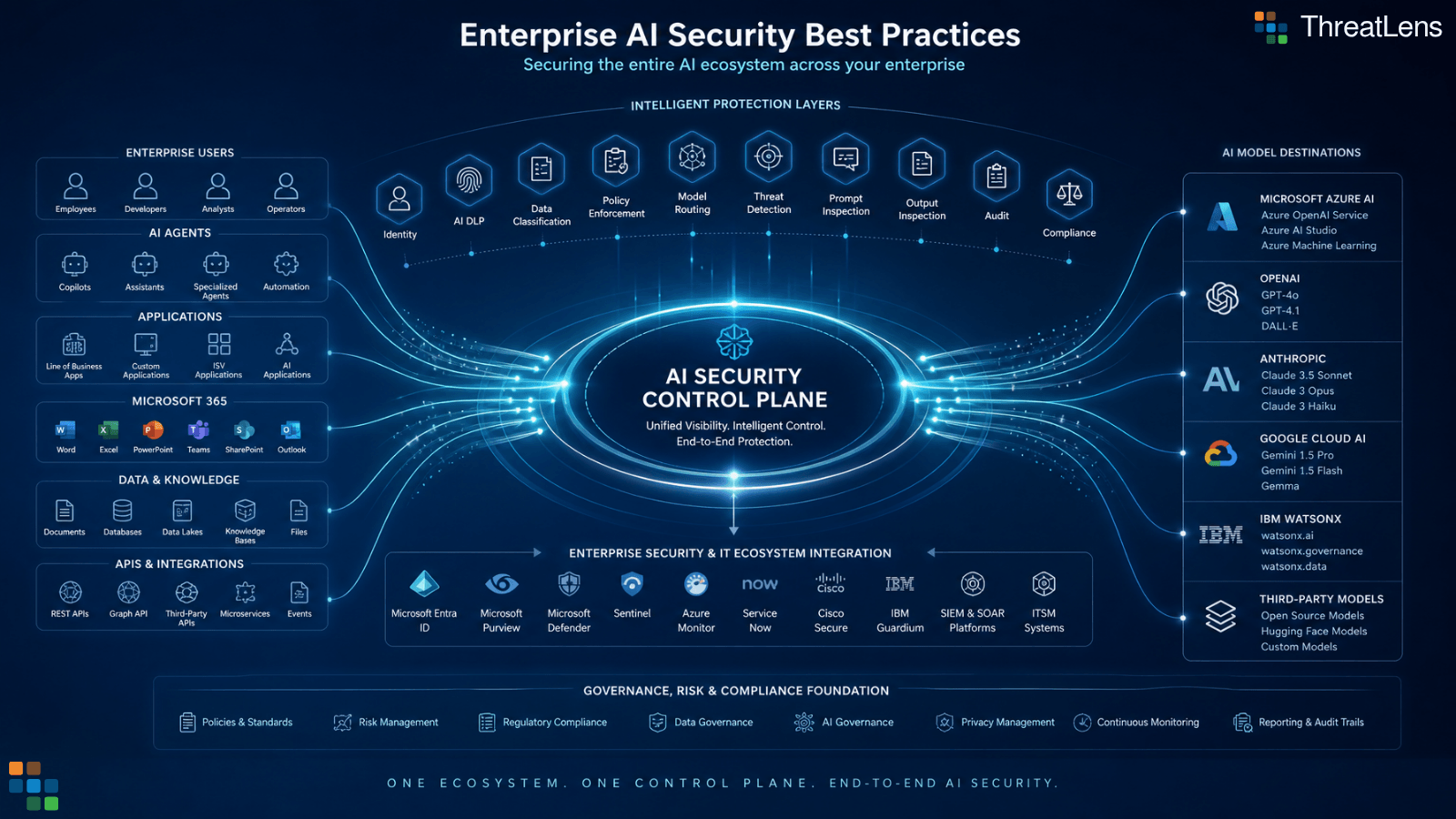
Most enterprises did not decide to adopt AI. They woke up already having adopted it. Employees signed up for ChatGPT on their own, turned on Copilot because it shipped with the license, and started pasting work into whatever tool was fastest. By the time security gets asked to "make AI safe," the usage is already everywhere, and most of it is invisible.
Enterprise AI security is the discipline of making that reality safe without grinding productivity to a halt. It is not antivirus for AI, and it is not a single product. It is a set of controls and practices that let your organization use AI — public chatbots, copilots, private models, and the AI features buried inside SaaS — while keeping sensitive data, regulated workloads, and your attack surface under control.
This guide is written for the people who own that problem: CISOs, security architects, heads of AI, compliance and risk leaders, and the Microsoft 365 administrators who quietly run half of it. It explains the threat model from first principles, why traditional controls miss it, the practices that actually work, how to map them to compliance, and a realistic roadmap to get from "we have no idea what's happening" to "every AI interaction is governed and provable."
Why This Topic Matters Now
Adoption already outran governance. In McKinsey's 2025 State of AI survey, 78% of organizations reported using AI in at least one business function, and 71% said they regularly use generative AI — up from 65% in early 2024 (McKinsey). That curve is steeper than most security programs can move.
The data follows the people. Cyberhaven's analysis of real enterprise usage found that the share of corporate data going into AI tools that was sensitive rose to 27.4% in early 2024, while the total volume of corporate data entering AI tools grew 485% year over year (Cyberhaven). A large share of that flows through personal accounts and unmanaged browser tabs — the textbook definition of shadow AI.
Regulators noticed. The bulk of the EU AI Act's obligations for high-risk systems begin applying on 2 August 2026, with penalties that can reach 7% of global annual turnover (EU AI Act timeline). The security community responded too: the OWASP Top 10 for LLM Applications (2025) codified the AI-specific risk classes — prompt injection, sensitive information disclosure, data and model poisoning, excessive agency, and more (OWASP).
The takeaway is not panic. It is timing. AI security is moving from "interesting" to "expected," and the organizations that build the practice now will not be scrambling when an auditor, a regulator, or an incident forces the question.
Core Definition
Enterprise AI security is the set of controls, policies, and practices that protect data, models, and users across the full lifecycle of AI use — from the prompt an employee types to the model that answers and the systems that act on the result.
It spans three overlapping concerns:
- Securing data in AI use. Preventing sensitive or regulated data from leaking into AI tools, and preventing AI outputs from surfacing data the user should not see. This is where AI DLP (AI data loss prevention) lives.
- Securing the AI systems themselves. Protecting models, prompts, retrieval pipelines, and integrations from manipulation — prompt injection, poisoning, model abuse, and the over-permissioned agents that act on their own.
- Governing AI behavior. Deciding which tools and models are approved, who can use them for what, and proving those decisions were enforced.
The unifying idea: enterprise AI security is about governing interactions, not just guarding a perimeter. The sensitive moment is no longer a file leaving the building. It is a conversation with a model — typed, pasted, uploaded, or retrieved — and what that conversation is allowed to do.
Why Traditional Controls Are Not Enough
Most enterprises already own a stack of mature controls: DLP, CASB, secure web gateways, endpoint protection, identity governance. These are good tools. They were built for a model of data movement that AI quietly broke.
Traditional controls assume data moves as files through known channels — email, endpoint, web upload, cloud storage — in recognizable formats, to destinations you can reason about. AI breaks all three assumptions:
- Employees paste prompts instead of sending files. A DLP rule watching for a spreadsheet attachment never fires when the same numbers are pasted into a chat box.
- Employees upload documents directly into AI tools. A board deck or a contract leaves in a single action, to a third-party model API that looks like ordinary HTTPS traffic.
- Sensitive context appears inside conversations. Source code, customer data, payment data, board strategy, HR records, and legal content get mixed with ordinary productivity requests, in unstructured prose where context decides sensitivity.
- Destinations have different trust levels. A public chatbot, an enterprise-managed deployment, a customer-managed tenant, and a private local model are not equivalent — but a flat allow/block rule treats them the same.
A blanket firewall block does not fix this; it just pushes usage onto personal devices and unmanaged tabs, making the problem invisible instead of absent. The principle that matters: the same data should receive the same governance outcome whether it is typed, pasted, uploaded, or retrieved from an enterprise knowledge base. Traditional controls cannot deliver that because they never see the interaction. AI security adds the missing control surface.
Why Enterprises Care
Three pressures converge, and they rarely sit with one person — which is exactly why AI security needs a named owner.
Data exposure. The headline fear is sensitive data leaving through a prompt or an upload, landing somewhere with unclear retention, logging, or training use. The inverse is just as real: AI that inherits a user's permissions can surface data inward. Microsoft Copilot, for example, answers from what the user can already access, so an over-shared SharePoint site becomes an over-shared answer.
New attack surface. Models and the pipelines around them are attackable. Prompt injection can turn a helpful assistant into a data-exfiltration channel. Poisoned data or compromised model endpoints can corrupt outputs. Over-permissioned agents — "excessive agency" in OWASP's terms — can take actions no human reviewed.
Compliance and defensibility. When an auditor or regulator asks how you control sensitive data in AI usage, "we trust employees" is not an answer. Enterprises need enforceable policy and evidence that it ran.
The cost of getting this wrong is concrete: a single regulated-data leak through a public model can trigger breach-notification duties, contractual penalties, and board-level scrutiny. The cost of overcorrecting is quieter but just as damaging — ban AI outright and you lose the productivity while the usage simply moves out of sight.
Common Enterprise Risk Scenarios
Naming the scenarios makes the controls concrete. These are the patterns that recur across real programs.
Prompt-based data exposure. A developer pastes proprietary source code into a public chatbot to debug it. A finance analyst pastes unreleased numbers to draft commentary. The data is now in a third-party prompt.
Document upload leakage. An employee uploads a signed contract, an M&A model, or a board presentation to "summarize it." An entire sensitive document leaves in one click.
Inbound exposure through responses. A copilot retrieves and surfaces content from an over-permissioned index, exposing salaries, customer lists, or legal memos to someone who should not see them.
Shadow AI. Teams adopt unsanctioned tools faster than security can vet them, often through personal accounts. The riskiest usage is the usage you cannot see.
Prompt injection and manipulation. A malicious instruction hidden in a web page, email, or document hijacks an AI assistant that has tool or data access, turning it against you (OWASP LLM01).
Excessive agency. An AI agent with broad permissions queries databases, calls APIs, or sends messages on its own, with no human in the decision path (OWASP LLM06).
Retrieval and embedding weaknesses. Poorly governed RAG pipelines leak data through vector stores or return content from documents the user was never entitled to (OWASP LLM08).
Training and retention. Data fed to some services is retained or used to improve models. An "ephemeral" conversation becomes a durable copy outside your boundary.
How It Works
Effective enterprise AI security is not one product bolted on at the end. It is a layered practice. Conceptually, every AI interaction should pass through the same governed path.
1. Discovery. You cannot govern what you cannot see. Inventory which AI tools, copilots, embedded SaaS features, and models are actually in use — sanctioned and unsanctioned. This is the foundation; everything else has blind spots without it.
2. Interception at a control point. Route AI traffic through a chokepoint — an AI gateway, proxy, browser control, or platform integration — so prompts and files can be inspected before they reach a model.
3. Inspection and classification. Analyze the prompt and any uploads in real time. Combine deterministic matching (patterns for card numbers, national IDs, secrets) with context-aware classification for unstructured content where meaning decides sensitivity.
4. Policy and trust evaluation. Check the classified content against policy, scoped by user, group, data class, and destination trust tier. The same data class should map to the same outcome regardless of how it entered.
5. Decision and enforcement. Take a graduated action — covered next — rather than a binary block.
6. Least-privilege for AI. Limit what models, copilots, and agents can retrieve and act on, so a compromised prompt cannot reach data the user should not see (OWASP LLM05).
7. Tamper-evident audit. Record the full governance decision — what was detected, which policy fired, what action was taken, which destination, and when — in a form that survives scrutiny.
Beyond Blocking: The Decisions AI Security Must Support
Treating AI security as "block the bad stuff" fails in practice, because most AI use is legitimate and valuable. Enterprise AI DLP must support a spectrum of outcomes:
- Allow — low-risk interactions pass unchanged, so real work is never slowed.
- Redact then send — strip or tokenize sensitive values (a customer name becomes a placeholder) and forward a sanitized prompt. The user keeps working; the regulated data never leaves your boundary.
- Route to a more trusted destination — send a sensitive request to an approved enterprise-managed model (Azure OpenAI, AWS Bedrock, or a private model) instead of a public endpoint.
- Block — reserved for genuinely forbidden content, with a clear explanation so the control builds trust rather than resentment.
- Model access control — restrict which users and groups can reach which AI models and destinations.
- Log the full decision — every outcome above becomes audit evidence.
This is the core philosophy: govern and enable most AI usage; block only what truly must be blocked.
Architecture or Framework
A reference architecture for enterprise AI security routes every interaction through one governed path:
- Employee request
- AI workspace / gateway
- Prompt & file inspection
- Data classificationPII, secrets, IP, PHI, financial
- Policy & trust matrixdata class × destination trust tier
- DecisionAllow / Redact / Route / Block
- Approved AI destinationprivate, enterprise, or customer-managed
- Tamper-evident audit logdecision, policy, destination, timestamp
Every AI interaction follows one governed path, from inspection to a tamper-evident audit log.
The business meaning matters more than the boxes. The gateway is the single place where policy becomes consistent; scatter the controls across tools and they drift apart. Inspection and classification are where you stop relying on employee judgment and start relying on policy. The policy and trust matrix is where the business expresses risk appetite in terms it understands — data classes, user groups, approved destinations — rather than in firewall rules. The decision step is where governance becomes enabling rather than obstructive. And the audit log is what converts a security control into a compliance asset: if you cannot prove the control ran, from a regulator's view it did not.
A practical organizing concept layered on top is the trust tier. Not all destinations are equal: a private, internally hosted model sits at the top; an enterprise-managed vendor model under a no-training contract sits below it; a customer-managed tenant differs again; a public consumer chatbot sits at the bottom. Policy references the tier, so the same data can be allowed to a trusted destination and blocked or redacted to an untrusted one. This matches how risk actually varies far better than a flat allow/block list.
Real-World Workflow Example
Concrete beats abstract. Here is a single interaction governed end to end:
- Employee asks“Summarize this board presentation.”
- AI security detectsStrategy & financial-planning content (sensitive)
- Policy requiresEnterprise-managed or customer-managed AI only
- Action takenRoute to approved Azure OpenAI / AWS Bedrock
- User seesGovernance decision shown before the answer
- Audit recordsClassification, action, destination, policy, timestamp
A single sensitive request, governed end to end — classified, routed to an approved model, and audited.
The employee still gets their summary. The sensitive content never touches a public model. The security team holds a record proving the control ran, mapped to a policy. No one had to choose between productivity and protection — which is the entire point. The same pattern applies whether the trigger is a typed prompt, a pasted block of code, an uploaded contract, or a retrieval from enterprise knowledge.
Comparison Table: Traditional DLP vs AI DLP
Traditional DLP is not obsolete — it still covers email, endpoints, and file movement. AI DLP covers the prompt-and-response path those tools were never designed to see. Most enterprises run both.
Best Practices
Discover before you police. Start with visibility into real AI usage, including shadow AI. Policy written for traffic you have not seen will be wrong.
Run monitor mode before enforcement. Deploy in observe-only mode first. Learn where sensitive data actually flows and where your policies would have fired. Tune false positives before you turn on blocking. This monitor-to-enforce progression is the single biggest predictor of whether a program survives contact with users.
Give people a sanctioned path. Enforcement without an alternative just creates shadow AI. Pair controls with an approved, governed way to use AI — a governed workspace and approved models — so employees have no reason to route around you. The goal is secure AI adoption, not prohibition.
Lead with redaction and routing, not blocking. A blocked prompt is a frustrated employee. A redacted or rerouted prompt is a productive one whose regulated data stayed home. Reserve hard blocks for content that genuinely must be blocked.
Define data classes and approved destinations explicitly. Map your existing data classification to AI-specific outcomes, and decide in advance which destinations are approved for each class. Reuse the identity groups and labels you already have rather than inventing a parallel taxonomy.
Tighten what AI can reach, not just what users type. Inbound risk is real, especially with copilots that inherit permissions. Reduce the permission hygiene the AI draws from so over-shared data cannot surface.
Constrain agent permissions. Treat AI agents like any privileged identity: least privilege, scoped tool access, and human approval for high-impact actions. Excessive agency is a top LLM risk for a reason.
Secure the retrieval pipeline. Apply access controls to vector stores and RAG sources so retrieval cannot return what the user is not entitled to see.
Measure and report. Track interactions inspected, sensitive items detected, actions taken, and false-positive rate. Metrics justify the program and guide tuning.
Common Mistakes
Assuming existing DLP already covers AI. It usually does not, because it watches files and channels, not prompt semantics. Validate the gap before assuming coverage.
Banning AI outright. A blanket block drives usage into channels you cannot see — worse than the original problem, and it costs you the productivity too.
Going straight to enforcement. Aggressive blocking before tuning produces false positives, complaints, and workarounds. The control loses credibility and the program stalls.
Ignoring response and retrieval risk. Focusing only on outbound prompts leaves inbound exposure — over-permissioned retrieval and leaked secrets in answers — wide open.
Forgetting agents and integrations. Human chat is only part of the surface. Agentic and API-driven flows move data with no human watching.
Treating audit as an afterthought. If logging is bolted on late, the program cannot answer the compliance question it was built to answer.
One-and-done. AI tools, models, and attacker techniques change constantly. A static policy decays.
Compliance and Audit Considerations
No regulation names a single "AI security" product, but several regimes create obligations that these practices help satisfy. Treat the mapping as practical, not legal advice, and confirm specifics with counsel.
EU AI Act. High-risk obligations largely begin applying on 2 August 2026, with penalties up to 7% of global turnover (timeline). Controlling and documenting how regulated data flows into AI systems supports the data-governance and record-keeping expectations.
ISO/IEC 42001. The AI management system standard, certifiable through accredited bodies. Enforced policy and audit trails provide the operational evidence such a system is expected to run.
NIST AI Risk Management Framework. A voluntary U.S. framework whose "govern, map, measure, manage" functions align closely with discovery, classification, enforcement, and monitoring.
OWASP Top 10 for LLM Applications (2025). A practical threat checklist — prompt injection, sensitive information disclosure, excessive agency, and more — to test your controls against (OWASP).
DORA and NIS2. DORA applies to the EU financial sector from 17 January 2025 and pulls third-party providers into scope; NIS2 sets cybersecurity baselines for critical sectors, where a prompt-injection leak or compromised endpoint is a reportable incident.
GDPR, PCI DSS, HIPAA. The established data-protection regimes still apply when personal data, cardholder data, or protected health information flows into an AI tool. AI security is a practical way to detect, prevent, and evidence that handling.
The throughline: AI security turns "we have a policy" into "we can prove the policy ran on every interaction," which is what auditors and regulators actually ask for.
Implementation Roadmap
A pragm
atic rollout in five phases. Timelines flex with size and the maturity of your existing classification program, but the sequence holds.
Phase 1 — Discover (weeks 1–4). Inventory AI usage across the organization: which tools, which teams, which data, which models. Surface shadow AI. Establish the baseline and expect surprises.
Phase 2 — Classify and define policy (weeks 3–8). Define the data classes that matter, the trust tiers for destinations, and the approved models for each class. Decide what gets allowed, redacted, routed, or blocked — and for whom. Reuse existing identity and classification.
Phase 3 — Monitor (weeks 6–12). Deploy at the control point in observe-only mode. Watch real traffic against draft policies. Tune false positives and build the evidence that policies are sound.
Phase 4 — Enforce (weeks 10–16). Move to enforcement, starting with the highest-confidence, highest-risk policies. Lead with redaction and routing. Communicate clearly so users understand what changed and why. Expand as confidence grows.
Phase 5 — Operate and improve (ongoing). Treat it as a living program. Add coverage as new AI surfaces appear, retune against new techniques (test against the OWASP LLM Top 10), review metrics, and report to leadership.
Frequently Asked Questions
What is enterprise AI security? The set of controls and practices that protect data, models, and users across AI use — from the prompt typed to the model that answers and the systems that act on the result. It spans data protection (AI DLP), securing the AI systems themselves, and governing AI behavior.
How is AI security different from traditional data security? Traditional security watches files and channels. AI security governs interactions — prompts, uploads, retrievals, and the destination model — because that is where sensitive data now moves and where AI-specific attacks occur.
What is AI DLP, and how does it relate? AI DLP (AI data loss prevention) is the data-protection layer of AI security: it inspects prompts and files, classifies sensitive content, and enforces allow/redact/route/block decisions with an audit trail.
Why isn't blocking ChatGPT enough? Blocking drives usage to personal devices and the AI features embedded in SaaS you cannot block without breaking the tool. A governed, sanctioned path with inspection beats a blanket ban and keeps the usage visible.
How does this apply to Microsoft Copilot? Copilot answers from what the user can already access, so over-shared content becomes over-shared answers. AI security here means tightening the permission and labeling hygiene Copilot draws from and adding visibility and audit evidence over how it is used.
Can we route sensitive prompts to Azure OpenAI or AWS Bedrock? Yes. A common pattern is routing sensitive requests to an enterprise-managed deployment instead of a public endpoint, so employees keep using AI while data stays within governed infrastructure.
Does it support Claude, GPT, Gemini, and private models? A well-designed control point is model-agnostic. It governs interactions regardless of the destination by sitting in the traffic path rather than depending on one vendor.
What is prompt injection, and how do we defend against it? Prompt injection hides malicious instructions in content an AI processes, hijacking its behavior (OWASP LLM01). Defenses include input inspection and validation, least-privilege agent permissions, and not granting models unchecked tool access.
What are trust tiers and approved destinations? Trust tiers rank AI destinations by how much control you have — private, enterprise-managed, customer-managed, public. Policy references the tier so the same data gets the right outcome per destination.
How do we handle AI agents safely? Treat agents as privileged identities: least privilege, scoped tools, and human approval for high-impact actions. Constrain "excessive agency" (OWASP LLM06).
Will AI security slow down our teams? Done well, no. Inspection adds modest latency, and redaction/routing keep people productive. The aim is secure enablement, not friction.
How do we measure whether the program works? Track interactions inspected, sensitive items detected, actions taken, false-positive rate, and the share of AI usage flowing through governed paths versus shadow channels.
Which frameworks should we map to? For threats, the OWASP Top 10 for LLM Applications. For governance and compliance, NIST AI RMF, ISO/IEC 42001, and the relevant regulatory regimes (EU AI Act, GDPR, PCI DSS, HIPAA, DORA, NIS2).
What's the first step? Discovery. Find out which AI tools your organization actually uses and where sensitive data flows today. Everything else builds on that map.
Key Takeaways
Enterprise AI security governs interactions, not just a perimeter. The sensitive moment is now a conversation with a model — typed, pasted, uploaded, or retrieved — and what that conversation is allowed to do.
Traditional controls miss it because employees paste prompts and upload documents instead of sending files, to destinations with very different trust levels. AI DLP and an AI security gateway add the missing control surface.
The strongest programs enable most AI use and block only what must be blocked: they discover first, monitor before enforcing, lead with redaction and routing, tighten what AI can reach, and map audit evidence to the OWASP LLM Top 10 and the relevant compliance regimes.
Conclusion
Enterprise AI security is not a wall you build once. It is an operating discipline for a world where your most sensitive data now moves through conversations with models. The technology helps, but the program decides the outcome: discover honestly, classify what matters, define approved destinations, run in monitor mode, and move to enforcement once your policies are tested.
Pick a concrete starting point this quarter. Identify your AI usage channels, define the two or three data classes you most need to protect, choose the approved destinations for each, and turn on inspection in observe-only mode. The findings will tell you where the real exposure is — and they will fund the rest of the program. Safe AI adoption is achievable, but it is built deliberately, not bought off a shelf.
Where ThreatLens Fits
ThreatLens Governance is a sovereign AI control plane for enterprise AI adoption — one way to operationalize the practices in this guide. Instead of bolting controls onto each AI tool separately, ThreatLens provides a governed AI workspace and a single control point in the path of AI interactions, so prompts and files are inspected and governed consistently across the tools your organization actually uses.
In practice, that means a policy and trust matrix applied at the point of use: classify sensitive content, then allow, redact, route, or block based on the destination's trust tier. A sensitive request can be routed to an approved enterprise-managed model — Azure OpenAI, AWS Bedrock, or a private model — rather than a public endpoint. Users see the governance decision before the answer, which builds trust instead of resentment. Every decision lands in a tamper-evident audit record you can hand to an auditor.
The design follows the philosophy throughout this guide: govern and enable most AI usage, block only what truly must be blocked. ThreatLens supports a monitor-to-enforce rollout, so you can observe real traffic and tune policy before turning on enforcement, and it extends to new AI surfaces — chatbots, copilots, agents, and retrieval — as they appear.
If you are starting an enterprise AI security program, the practical next step is discovery: map where sensitive data flows into AI today. From there, a control plane like ThreatLens Governance can turn that map into enforced, auditable policy. Learn more at thethreatlens.com.