AI Security & Governance for Financial Services
A practical guide to AI security and governance for financial services: banking AI risks, mapping DORA and PCI obligations, approved-model routing, and a governed rollout plan.
Introduction
Every financial institution wants to take advantage of AI. Relationship managers use it to draft client communications, analysts summarize research faster, developers accelerate software delivery, and operations teams automate repetitive work. The productivity gains are real, and the pressure to capture them is only increasing.
At the same time, security, risk, and compliance teams are asking a much harder question: what customer data is leaving our organization, where is it going, and can we prove we still have control over it?
For financial institutions, AI governance is no longer optional. It is the foundation that enables AI adoption while protecting customer data, meeting regulatory obligations, and maintaining trust. A generic "use AI responsibly" policy does not survive contact with a trading floor or a contact center; what banks need is enforceable control at the point where data meets the model.
This guide explains the banking-specific AI risks, the regulatory picture, the governance controls that work, and a practical roadmap for adopting AI securely — without slowing the business down.
A Typical Banking AI Scenario
Imagine a relationship manager preparing a response to a high-net-worth client. To save time, they copy the client's portfolio summary, recent transactions, and investment preferences into an AI assistant to draft an email. The AI produces an excellent response in seconds.
But several important questions remain:
- Was customer PII exposed?
- Did regulated financial information leave the organization?
- Was the AI model approved for this kind of data?
- Can compliance prove what happened?
- Is there an audit record?
Nothing about this interaction was malicious. The employee was being efficient. Yet in a few seconds, regulated client data may have left the bank's control, with no classification, no policy decision, and no record. Multiply that by thousands of employees and dozens of AI tools, and you have the core reason AI governance is becoming a core operational control for financial institutions.
Why AI Adoption Is Accelerating in Financial Services
Enterprise AI adoption is broad — in McKinsey's 2025 State of AI survey, 78% of organizations reported using AI in at least one business function, with 71% regularly using generative AI (McKinsey). Financial services is squarely in that wave, and the pressure to adopt is structural, not faddish.
Three forces push banks toward AI. First, cost and efficiency: AI compresses the manual analyst work in research, underwriting, KYC review, and operations. Second, client experience: copilots and assistants speed up advisor workflows and customer support. Third, competition: fintechs and digital-first challengers move quickly, and incumbents cannot afford to wait.
The catch is that adoption is outrunning governance. Much of the real usage is shadow AI — staff using personal ChatGPT accounts or unsanctioned tools because the approved path is slower or does not exist. Across enterprises, the volume of corporate data flowing into AI tools grew sharply, and a rising share of it is sensitive (Cyberhaven). In a bank, that "sensitive share" is account numbers, balances, and strategy. The job is not to slow adoption — it is to make the fast path the safe path.
Industry-Specific AI Risks
Generic AI risk lists miss what makes banking different. The risks that matter here cluster around regulated data, money movement, and trust.
Customer data exposure. Account numbers, balances, transaction history, and personally identifiable information get pasted into prompts to "summarize this customer" or "draft a response." Once in a public model, retention and downstream use are outside your control.
Payment and card data. Cardholder data (PAN, CVV) pasted into a chatbot is a direct PCI DSS concern. AI adds a new, unmonitored path for this data to leave scope.
Material non-public information and market abuse. Deal terms, earnings ahead of release, and trading positions are MNPI. Leaking them through an AI tool is not just a data incident — it touches insider-trading and market-abuse regimes.
Fraud and social engineering, now AI-assisted. Generative AI lowers the cost of convincing phishing, synthetic identities, and deepfake voice in contact centers. The same tools your staff use can be turned against your customers.
Insider risk. A departing employee can exfiltrate client lists or models through an AI prompt as easily as through email — and your traditional DLP may not see it.
Model and code leakage. Proprietary trading logic, pricing models, and source code pasted into AI assistants are core intellectual property walking out the door.
Inbound exposure through copilots. A copilot that inherits a user's permissions can surface data the user should not see — over-shared deal folders, HR records, or another desk's positions — turning an answer into a need-to-know breach.
Prompt injection and agentic risk. As banks deploy AI agents that touch internal systems, hidden instructions in documents or emails can hijack them (a recognized class in the OWASP Top 10 for LLM Applications, 2025) (OWASP).
Why Traditional Controls Are No Longer Enough
Traditional controls such as email DLP, CASB, secure web gateways, and endpoint protection were designed before generative AI became part of everyday work. They assume data leaves the organization as a file, through a known channel, in a recognizable format.
AI changes the way information leaves the organization. Instead of sending files, employees now copy and paste sensitive information directly into AI assistants, upload confidential documents for analysis, or use AI integrated into productivity applications like Microsoft 365. These interactions often bypass traditional security controls entirely: a DLP rule watching for a spreadsheet attachment never fires when the same figures are pasted into a chat box, and a web gateway sees only ordinary encrypted traffic to an AI provider.
The implication is simple but important. Organizations need governance at the AI interaction itself — inspecting the prompt, the file, and the response — not only at the network or endpoint. That is the control surface AI introduced, and it is the one banks are currently missing.
Regulatory and Compliance Considerations
Financial services already operates under dense regulation, and AI use does not get a carve-out. Treat the following as practical mapping, not legal advice — confirm specifics with your compliance and legal teams.
DORA. The EU Digital Operational Resilience Act applies to the EU financial sector from 17 January 2025 and pulls third-party technology providers — including AI vendors — into scope (DORA overview). Your AI supply chain and its resilience are now examinable.
EU AI Act. Certain financial uses, such as credit scoring and creditworthiness assessment, fall into high-risk categories, with the bulk of high-risk obligations beginning to apply on 2 August 2026 (EU AI Act timeline). for the specific Annex classification of a given use case.
PCI DSS. Cardholder data flowing into AI tools is in scope; controls must prevent PAN/CVV from reaching unapproved destinations.
GDPR and regional privacy law. Personal data of customers in prompts or outputs triggers data-protection obligations, including lawful basis, minimization, and records of processing.
Model risk and supervisory expectations. Long-standing model-risk management expectations (for example, U.S. SR 11-7) and conduct rules apply when AI informs decisions; document model use, validation, and oversight.
Sectoral cyber rules. Regimes such as NYDFS Part 500 and NIS2 set cybersecurity baselines; an AI-driven data leak or a compromised model endpoint is a reportable security event under several of them.
The throughline for examiners is the same one you already know: enforceable policy plus evidence. AI governance has to turn "we have an AI policy" into "we can prove what every AI interaction was allowed to do, and why."
Common AI Use Cases
AI in banking is not one thing; the governance outcome should depend on the use case and the data it touches.
- Customer service & advisor copilots — Customer PII, account data: Redact or route
- Research & document summarization — Filings, MNPI, internal memos: Block MNPI to public models; route
- KYC/AML review assistance — PII, sanctions, case data: Enterprise-managed AI only; audit
- Code and model assistance — Source code, trading logic: Block secrets; route to approved AI
- Fraud and risk analytics — Transaction data, PII: Private/enterprise models; logging
- Operations & reconciliation automation — Payment data, ledgers: Restrict destinations
- Marketing and content drafting — Mostly public/low-risk: Allow with light monitoring
The pattern: most use cases are valuable and should be enabled — through the right destination, with the right handling — not blocked. Only a few data classes (secrets, raw card data, MNPI to public tools) warrant a hard stop.
AI Governance Best Practices
Effective AI governance for a bank is built from a consistent set of controls. Think of these as the operating capabilities your program needs, applied to every AI interaction.
- Classification — identify the data classes that matter (PII, card data, MNPI, source code, secrets, HR, legal) in prompts, files, and retrieved content, in real time.
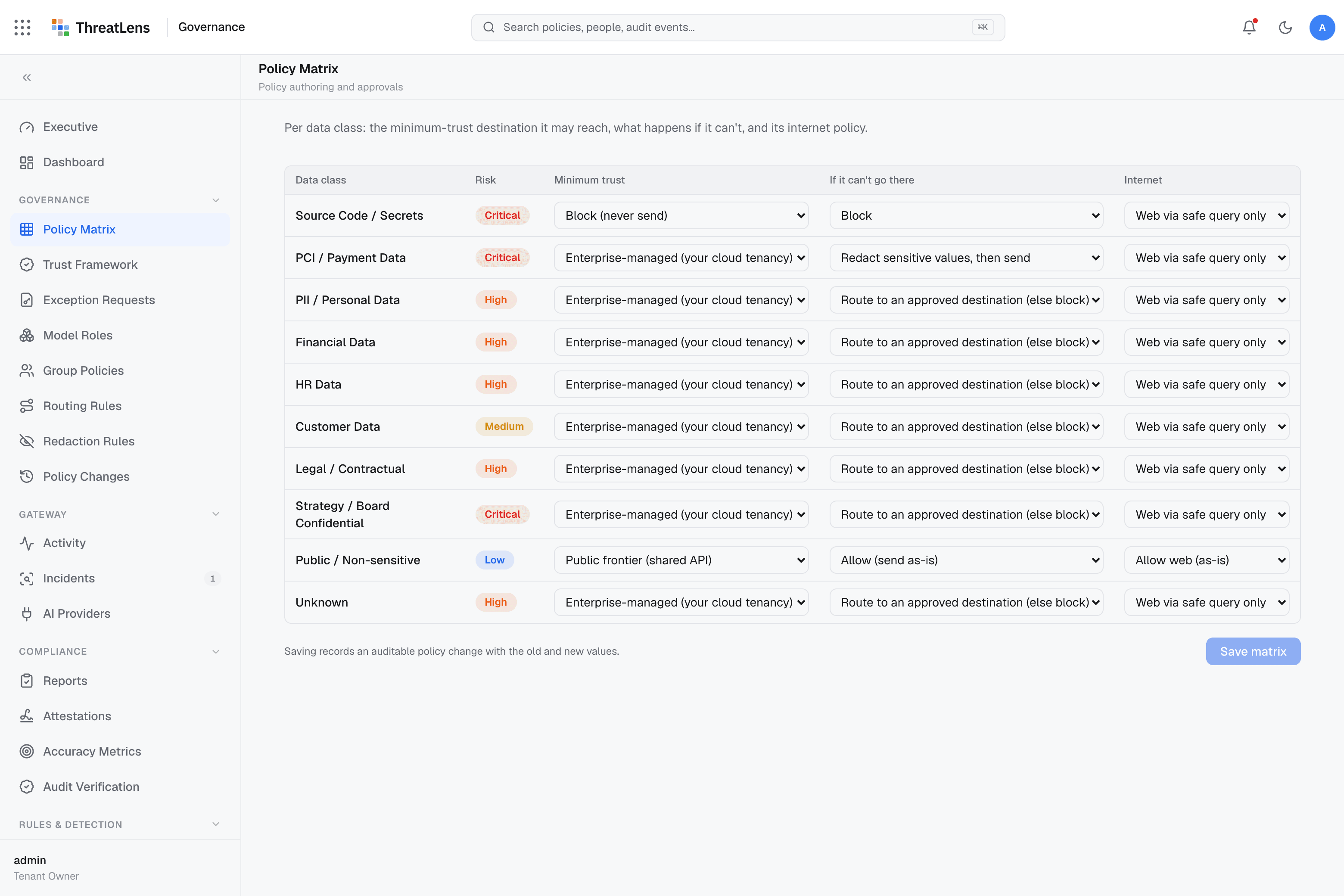
- Policy matrix — express, in business terms, what happens to each data class in each context. This is where risk appetite becomes enforceable rules.
- Trust tiers — rank destinations: public frontier models, enterprise-managed, customer-managed, and private/local. Each data class maps to the tiers allowed for it.
- Approved AI models — maintain a catalog of sanctioned destinations so staff always have a fast, compliant option.
- Redaction — strip or tokenize sensitive values so the task still completes while the regulated data stays inside the bank.
- Routing — send sensitive-but-permitted content to a higher-trust destination instead of a public endpoint.
- Blocking — hard-stop the genuinely forbidden: secrets, credentials, raw card data, and MNPI headed to public tools.
- Model access control — restrict which users and groups can reach which AI models and destinations.
- Fail-closed enforcement — if inspection cannot complete, the request is blocked rather than passed to a model unchecked.
- Immutable audit — record every governance decision (classification, action, destination, policy, timestamp) in a tamper-evident log.
- Monitor mode — observe and baseline real usage before enforcing, so you tune classification and avoid false positives.
- Enforcement mode — apply the allow/redact/route/block decisions once policies are tested and stakeholders have signed off.
The unifying principle: enable most AI usage through approved destinations, and block only what is clearly forbidden. The fastest way to fail is to make the compliant path slower than the shadow one.
AI Governance Maturity Model
Most institutions can locate themselves on a simple maturity curve. The goal is to move up it deliberately — not to jump straight to enforcement.
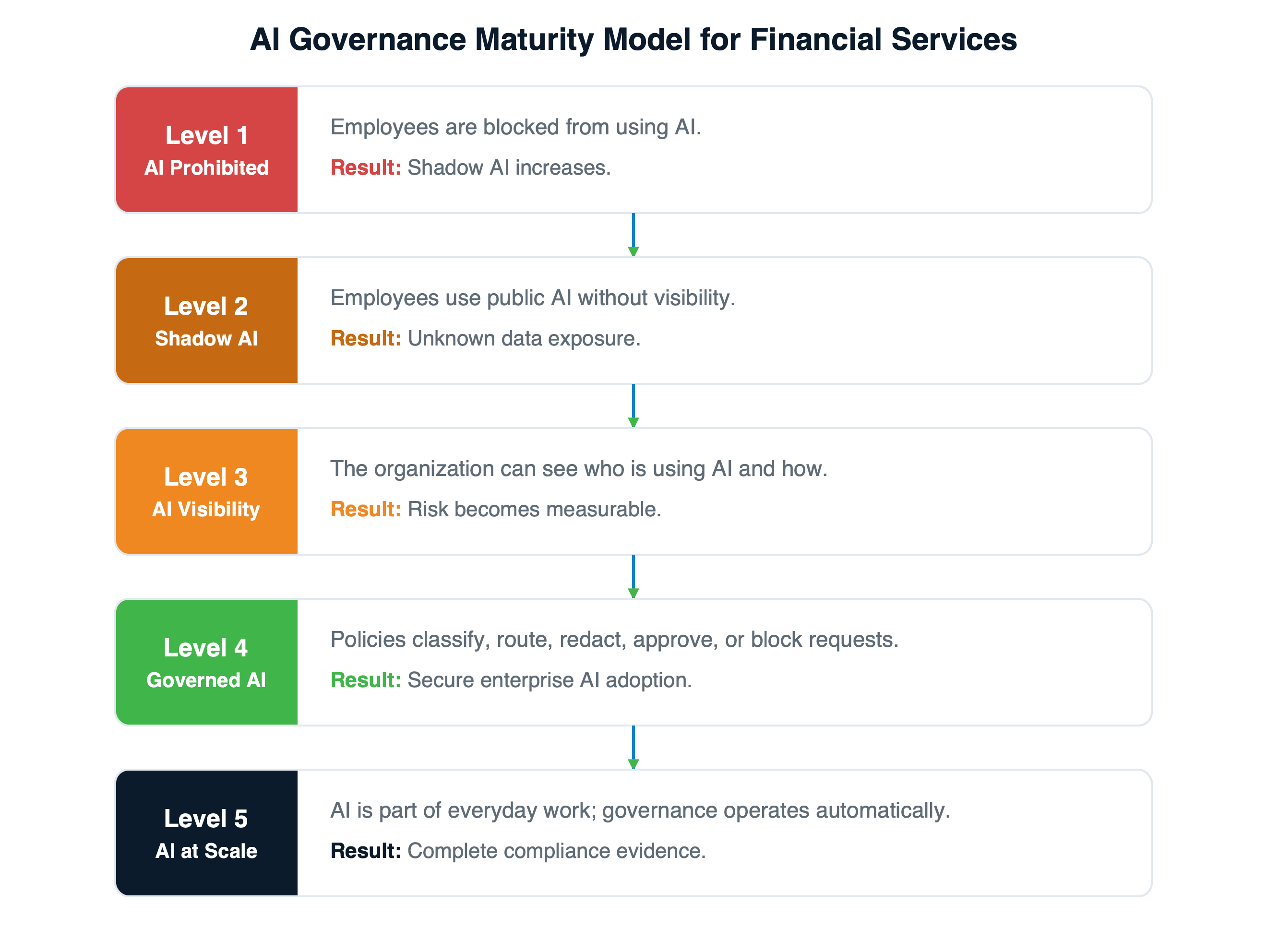
Level 1 — AI Prohibited. Employees are blocked from using AI. Result: shadow AI increases as staff route around the ban.
Level 2 — Shadow AI. Employees use public AI without visibility. Result: unknown, unmeasured data exposure.
Level 3 — AI Visibility. The organization can see who is using AI and how. Result: risk becomes measurable, and policy can be written for real traffic.
Level 4 — Governed AI. Policies classify, route, redact, or block requests at the point of use. Result: secure enterprise AI adoption with evidence.
Level 5 — AI at Scale. AI is part of everyday work, governance operates automatically, and compliance has complete evidence. Result: innovation and control reinforce each other instead of competing.
The trap is Level 1: prohibition feels safe but produces Level 2 in practice. The fastest sustainable path is to get to visibility quickly, then govern.
Recommended Architecture
Route every AI interaction through one governed lifecycle so policy is consistent, decisions are explainable, and evidence is examiner-ready:
- Employee
- Governed AI workspace
- Prompt & file inspection
- Classification engine
- Policy matrix
- Trust tier evaluation
- Decisionallow | redact | route | block
- Approved AI model
- Immutable audit log
- Compliance reporting
The operating implications matter as much as the technical ones. The governed workspace and gateway give compliance one place to express policy instead of chasing every tool. Classification and trust-tier evaluation move the bank off "trust the employee" and onto enforceable rules tied to how much control you have over each destination. The tamper-evident audit log turns the control into examiner-ready evidence — if you cannot prove the control ran, supervisors will treat it as if it did not.
Decision Tree: Routing an AI Request in a Bank
- Does the request contain secrets, credentials, or raw card data (PAN/CVV)Yes: block and log. · No: continue.
- Does it contain MNPI or material deal/market informationYes: block to public tools; route to approved enterprise-managed AI; log. · No: continue.
- Does it contain customer PII or regulated dataYes: redact where possible, or route to enterprise/customer-managed AI. · No: continue.
- Is the destination trusted enough for this data classYes: allow and log. · No: route or block.
Adapt the thresholds to your risk appetite, but keep the shape: hard-stop the few truly forbidden classes, route or redact the sensitive-but-permitted majority, and allow low-risk work freely — always with a log.
Implementation Roadmap
A realistic rollout for a bank runs in phases, with compliance and the business in the room from the start.
Phase 1 — Discover (weeks 1–4). Inventory AI usage across desks and functions, including shadow AI. Identify which tools, which teams, and which data classes are involved. Expect to find usage no one approved.
Phase 2 — Classify and design policy (weeks 3–8). Build your data-class matrix and trust tiers. Decide, per class, what is allowed, redacted, routed, or blocked. Align with compliance, model risk, and the relevant business heads.
Phase 3 — Monitor (weeks 6–12). Deploy the governed workspace/gateway in observe-only mode. Baseline real traffic, tune classification against false positives, and gather the evidence that policies are sound.
Phase 4 — Enforce gradually (weeks 10–16). Turn on enforcement starting with the clearest, highest-risk rules (secrets, card data, MNPI to public tools). Lead with redaction and routing elsewhere. Communicate changes so staff understand the why.
Phase 5 — Operate and report (ongoing). Treat governance as a living control. Add coverage as new AI tools appear, review metrics, test against the OWASP LLM Top 10, and report to risk committees and, when asked, examiners.
AI Governance Checklist for Financial Institutions
A short, practical checklist to pressure-test your program:
- Inventory AI applications currently in use
- Identify shadow AI across desks and functions
- Define enterprise data classifications
- Establish AI trust tiers for destinations
- Approve a catalog of enterprise AI models
- Block high-risk public AI destinations for regulated data
- Implement AI DLP (prompt and file inspection)
- Enable immutable audit logging
- Produce audit-ready governance evidence
- Begin in monitor mode before enforcing policies
Why ThreatLens Fits This Industry
ThreatLens Governance is a sovereign AI control plane for enterprise AI adoption — built for exactly the constraints financial services operates under. Rather than bolting controls onto each tool, it puts a governed AI workspace and a single control point in the path of AI interactions, so prompts and files are inspected and governed consistently across the bank.
Unlike point solutions that simply block access to AI tools, ThreatLens governs every AI interaction using policy-based decision making. It enables organizations to classify sensitive information, apply trust-based routing, inspect prompts and files, and maintain an immutable audit record — without forcing employees to abandon AI.
In practice, that means a policy and trust matrix applied at the point of use: classify customer PII, card data, MNPI, code, and secrets, then allow, redact, route, or block based on the destination's trust tier. A sensitive research request can be routed to an approved enterprise-managed model — Azure OpenAI, AWS Bedrock, or a private model — while raw card data or credentials are blocked outright. Staff see the governance decision before the answer.
For examiners, the value is the tamper-evident audit record: every decision — classification, action, destination, policy, timestamp — captured in a tamper-evident record. ThreatLens supports a monitor-to-enforce rollout, so a bank can baseline real usage and tune before enforcing, and its sovereign deployment model suits data-residency and operational-resilience expectations. Learn more at thethreatlens.com.
Frequently Asked Questions
Can banks use public AI tools like ChatGPT safely? Yes, for low-risk work, and with guardrails. The safe pattern is a governed path that inspects prompts, blocks secrets and card data, and routes regulated or sensitive content to an approved enterprise-managed model rather than relying on staff judgment.
How does this address DORA? DORA brings third-party technology providers, including AI vendors, into operational-resilience scope from January 2025. A governed control point gives you inventory, control, and evidence over AI data flows and destinations — useful inputs for resilience and oversight obligations.
What about PCI DSS and card data? Cardholder data pasted into AI tools is a real exposure path. Governance should hard-block PAN/CVV from reaching unapproved destinations and log the attempt for evidence.
How do we handle MNPI and market-abuse risk? Treat MNPI as a top data class: block it from public tools, route it only to approved enterprise-managed AI, and keep an audit trail. Combine with your existing information-barrier controls.
Does this slow down traders and analysts? Done well, no. Most requests are allowed or redacted/routed automatically; only a few classes are blocked. The goal is to remove the reason to use shadow tools, not to add friction.
How does it work with Microsoft Copilot? Copilot answers from what a user can already access, so over-shared SharePoint or Teams content can surface in answers. ThreatLens helps you assess that exposure and tighten the underlying permissions and sensitivity labels Copilot relies on, and adds visibility and audit evidence across approved AI providers.
What's the difference between monitor mode and enforce mode? Monitor mode observes and logs without blocking, so you can baseline usage and tune classification. Enforce mode applies the allow/redact/route/block decisions. Always monitor first.
Where should we start? Build a data-class matrix for your bank, identify your approved AI destinations, and run monitor mode for 30–60 days before enforcing. That single step surfaces your real exposure and de-risks everything that follows.
Key Takeaways
AI adoption in financial services is accelerating for sound reasons, but the usage is outrunning governance, and the sensitive share of it — customer PII, card data, MNPI, model logic — is exactly what regulators and attackers care about.
The answer is not prohibition. It is a governed path: classify by data class, route to approved destinations by trust tier, redact where possible, block only the clearly forbidden, inspect outputs, and log every decision for examiners.
Start with discovery and monitor mode, bring compliance and the business in early, and move to enforcement gradually. Enable most AI usage safely; reserve hard blocks for the few classes that truly demand them.
Conclusion
Financial institutions don't have to choose between AI innovation and regulatory compliance. The organizations that succeed will be those that make the approved path the easiest path — allowing employees to benefit from AI while ensuring every interaction is governed, every decision is auditable, and every piece of sensitive data remains under enterprise control.
The concrete next step is small and high-leverage: build your data-class matrix, list your approved AI destinations, and run a 30–60 day monitor-mode baseline. The findings will show where your real exposure is and will justify the rest of the program.
Related reading: What Is AI DLP? · Enterprise AI Security Best Practices · What Is AI Governance? · AI Governance Checklist · Shadow AI Explained.