What Is an AI Gateway? The Definitive Enterprise Guide
Every enterprise now has AI traffic, whether it realizes it or not. Most enterprises cannot see it, cannot govern it, and cannot prove what happened after the fact. Employees paste customer records into ChatGPT. Developers wire applications directly to OpenAI, Anthropic, and Google endpoints. Microsoft Copilot reads across SharePoint and Exchange on behalf of users who never think about classification. Each of these is a data movement decision, made hundreds or thousands of times a day, with no consistent control in the middle.
An AI Gateway is the control point that sits in that middle. It is where AI traffic is inspected, governed, routed, and recorded before it reaches a model.
This guide explains what an AI Gateway is from first principles, why the concept emerged, how it differs from the infrastructure enterprises already run, and how to design and deploy one. It is written for the people who have to make AI adoption safe in practice: CISOs, security architects, heads of AI, compliance officers, and the Microsoft 365 administrators who inherit Copilot whether they asked for it or not.
AI Gateway at a Glance
- A central control point for enterprise AI traffic.
- Governs prompts, files, and the AI destinations they reach.
- Routes requests to approved AI models by policy, cost, and trust.
- Enforces AI DLP and governance policy inline: allow, redact, route, or block.
- Produces tamper-evident audit evidence for compliance.
Why This Topic Matters Now
Two things happened at once. AI became useful enough to change how work gets done, and it became easy enough that adoption stopped waiting for permission.
The result is that the "AI channel" is now one of the highest-volume, least-governed data egress paths in the enterprise. It does not look like the channels security teams built controls for. There is no attachment to scan at the mail gateway. There is often no file at all. A prompt is just text typed into a browser or streamed from an application, and that text can contain source code, a board deck, a patient record, a pricing model, or an entire customer database dumped in for "analysis."
The market responded with a category. Cloud and API vendors now ship products they call AI gateways, and infrastructure teams increasingly place one in front of their model calls. IBM describes an AI gateway as "a specialized middleware platform that facilitates the integration, deployment and management" of AI tools and large language models in an enterprise environment. That definition is accurate but incomplete for a security and compliance audience, because it emphasizes operational plumbing over governance. The rest of this guide treats the AI Gateway as both: the operational control plane for AI traffic and the enforcement point for AI security and data protection.
The timing also matters because regulation is arriving. The EU AI Act, ISO/IEC 42001, and the NIST AI Risk Management Framework all push enterprises toward demonstrable governance of AI systems rather than good intentions. You cannot demonstrate governance over a channel you cannot see. An AI Gateway is how many organizations will produce that evidence.
Core Definition: What Is an AI Gateway?
An AI Gateway is a policy-enforcing intermediary that sits between the people and applications that use AI and the AI models they use. Every request to a model passes through the gateway, where the gateway can inspect content, classify data, apply policy, route to an approved destination, redact or block sensitive material, and write a tamper-evident record of what it decided and why.
Read that again with the emphasis in a different place: it is a decision point, not just a pipe. A plain proxy forwards traffic. An AI Gateway forwards traffic only after making a governed decision about that specific request, based on who is asking, what is in the prompt, where it is going, and what policy applies.
Three properties separate an AI Gateway from the infrastructure it resembles.
First, it is content-aware in an AI-specific way. It understands prompts, completions, embeddings, tool calls, and file uploads as the meaningful units, not just packets and HTTP verbs. It can tell that a prompt contains a payment card number or that a completion is leaking a system instruction.
Second, it is model-aware. It knows there is a difference between a public consumer chatbot, an enterprise-tenant model under contract, a model hosted in your own cloud, and a private model running on your own hardware. It treats those as different trust levels with different allowed data classes.
Third, it is decision-oriented. Its output is not merely "allowed" or "denied." An enterprise AI Gateway supports a spectrum of outcomes: allow, redact then send, route to a more trusted destination, block, and always log. That spectrum is what lets an enterprise enable AI broadly instead of blocking it out of fear.
That last point is the philosophy worth stating plainly. The goal of an AI Gateway is not to stop AI. Most AI usage is legitimate and valuable, and blocking it by default just pushes people to their phones and personal accounts, which is worse. The goal is to govern AI so that it can be used widely and safely, with the few genuinely dangerous actions caught and the vast majority of good ones enabled with a light touch.
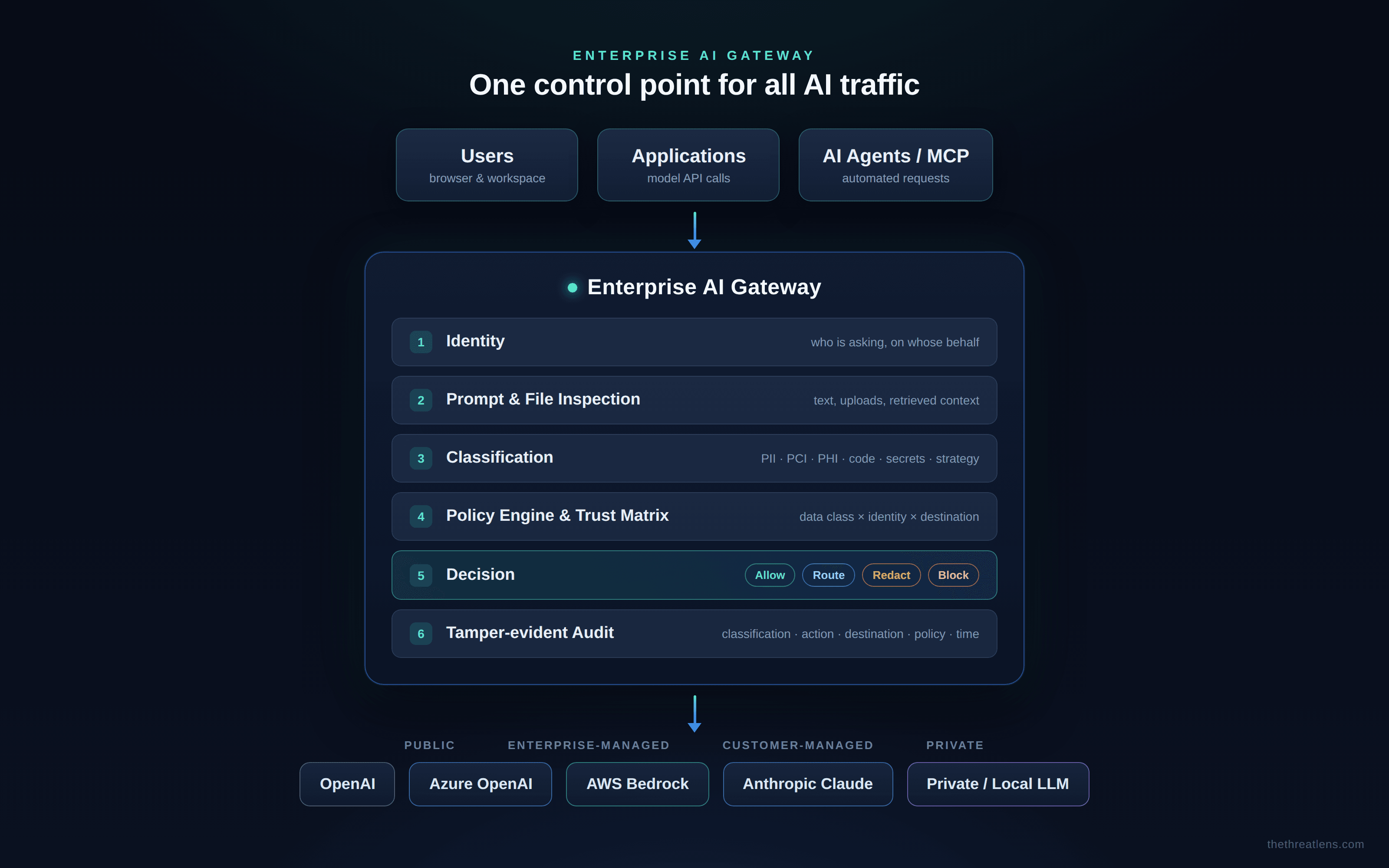
At its simplest, the gateway sits as a single control point between everyone who uses AI and every model they reach:
The AI Gateway as a single control point: every request from users, applications, and agents passes through identity, inspection, classification, policy, decision, and audit before reaching an approved model.
Everything else in this guide is an expansion of that one picture: what happens inside the box, and why each stage matters to security, the business, and compliance.
Why Traditional Controls Are Not Enough
Enterprises did not enter the AI era unprotected. They have firewalls, secure web gateways, cloud access security brokers, and data loss prevention. The problem is that none of these were designed for the shape of AI traffic, and each fails in a specific way.
Network firewalls and secure web gateways see destinations and, at best, categories of destinations. They can tell that a user is talking to chat.openai.com. They cannot tell whether that user is asking for a recipe or pasting the company's unreleased earnings. A destination-level allow or block is too blunt: block it and you lose the productivity, allow it and you lose the data.
Legacy data loss prevention was built around files and structured channels: email attachments, endpoint file operations, uploads to web forms. AI usage frequently involves no file at all. An employee copies text out of a document and pastes it into a prompt. The sensitive content now lives inside a conversation, in a channel the DLP engine was never taught to inspect, moving in a pattern it does not recognize. Even when a file is uploaded directly into an AI tool, many DLP deployments do not sit in that path.
CASB brought visibility to sanctioned and unsanctioned SaaS, and it remains useful for discovering which AI tools are in use. But CASB's model is oriented around applications and their API-level activity, not around the semantic content of a single prompt and the trust level of the specific model destination. Knowing that "150 people use an AI writing tool" is not the same as governing what each of those prompts contains and where the answer comes from.
API gateways, which many engineering teams already run, solve a different problem entirely. They authenticate callers, enforce rate limits, and route requests among services. They have no concept of a prompt, a data class, or an approved model tier. Putting model traffic through a standard API gateway gives you throttling and auth, not governance.
The common thread is that traditional controls key off the wrong signal. They watch channels, destinations, and files. AI risk lives in content and intent, expressed as prompts and completions, flowing to destinations that differ not by URL but by trust. An AI Gateway is the control that keys off those signals directly.
Why Enterprises Care
The reasons enterprises invest in an AI Gateway fall into three buckets that map neatly to how executives think about risk.
The security impact is data exposure and a new attack surface. Sensitive data leaving to an untrusted model is the obvious concern, but the surface is broader: prompt injection that manipulates an application's behavior, sensitive information disclosure in completions, system prompt leakage, and the excessive agency of AI systems that can take actions. The OWASP Top 10 for LLM Applications (2025) catalogs these, and the top entries, prompt injection and sensitive information disclosure, are exactly the risks a content-aware gateway is positioned to reduce.
The business impact is enablement without loss of control. Leadership wants AI adoption to move fast. Security wants it to be safe. Without a control point, those goals conflict and the usual outcome is a slow, restrictive policy that everyone routes around. An AI Gateway resolves the conflict by making broad adoption governable, so the answer to "can we use this?" becomes "yes, under policy" instead of "no" or an unmonitored "sure."
The compliance impact is provable governance. Regulators and auditors increasingly expect organizations to know what data flows to which AI systems, to enforce rules over that flow, and to produce evidence. A gateway that logs every decision, the classification, the action, the destination, the policy, the timestamp, the identity, turns AI governance from a policy document into an audit trail.
Common Enterprise Risk Scenarios
These are the situations that recur across programs, regardless of industry.
An engineer pastes a stack trace that includes production credentials and internal hostnames into a public chatbot to debug faster. The intent is good; the exposure is real and permanent.
A finance analyst uploads a board presentation into an AI tool to "summarize the key points." The deck contains unannounced financial results and M&A strategy, now sitting in a consumer service's conversation history.
A support agent pastes a batch of customer tickets, complete with names, emails, and account details, into an AI assistant to draft replies. Regulated personal data has left the environment through a channel no one is watching.
A developer builds a customer-facing feature on a model API. An attacker crafts input that injects instructions, causing the application to reveal its system prompt or misuse a connected tool. This is prompt injection and excessive agency, not a data-paste problem, and it needs inspection of application traffic, not just employee browsing.
Microsoft Copilot, granted broad access to a user's mailbox and files, surfaces content in a summary that the requesting user technically has permission to see but should not have had aggregated and exposed so easily. The risk here is not egress to a third party; it is over-permissioned retrieval inside the tenant.
Notice that the same underlying data, a customer record, source code, board strategy, should receive the same governance outcome whether it is typed, pasted, uploaded, or retrieved from an enterprise knowledge source. Consistency across those paths is the hard part, and it is the reason a single control point matters.
How an AI Gateway Works
Mechanically, an AI Gateway processes each AI interaction as a short pipeline. The stages are consistent even when vendors implement them differently.
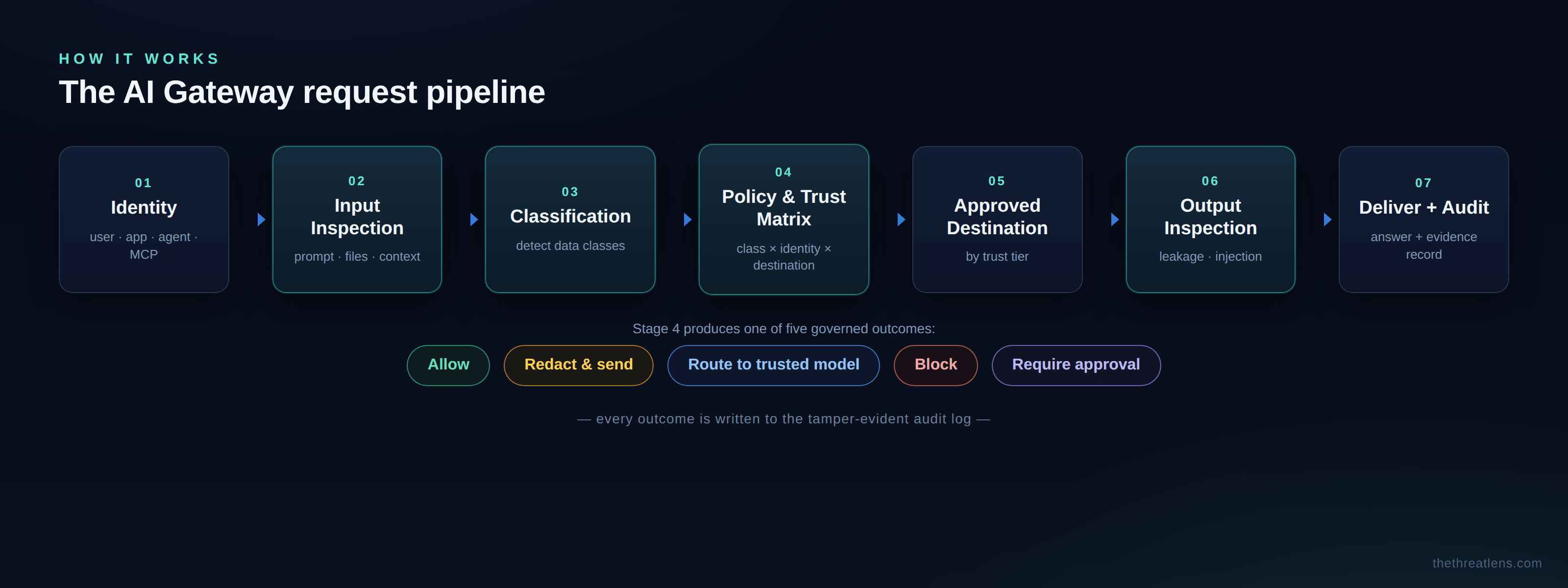
It begins with interception and identity. The gateway sits inline for AI traffic, as a proxy for browser-based tools, as the endpoint that applications call instead of the model provider directly, or as a governed workspace that users work inside. It attaches identity to the request: which user, which group, which application, which agent. As AI ecosystems evolve, gateways increasingly govern traffic originating not only from users but also from AI agents, applications, and Model Context Protocol (MCP) clients, the same inspection and policy apply no matter what initiates the request.
Next is input inspection. The gateway parses the prompt, any attached or uploaded files, and any retrieved context. It looks at content, not just metadata. Multimodal inputs, images, documents, audio transcripts, are inspected too, because sensitive data does not only arrive as plain text.
Then comes classification. Inspected content is matched against the data classes the enterprise cares about: personal data, payment data, health information, source code, credentials, and business-confidential categories like strategy, legal, and HR. Good classification blends pattern matching for structured identifiers with context-aware detection for the unstructured content that regular expressions miss.
With content classified, the gateway consults the policy and trust matrix. This is the core logic: for this data class, this user or application, and this requested destination, what is allowed? The trust matrix encodes the difference between a public model, an enterprise-managed model, a customer-managed model in your own cloud, and a private or local model.
The matrix produces a decision: allow the request as-is, redact the sensitive values and send the rest, route to a more trusted approved destination, or block the request outright. The request then reaches the approved AI destination, or does not.
Finally, every step is written to a tamper-evident audit log: the classification, the action taken, the destination, the policy that applied, the identity, and the time.
Two operational features sit alongside this governance pipeline because the same chokepoint is the natural place for them. Model routing lets the gateway send traffic to the best destination by cost, performance, availability, or policy, with failover across providers. Token-level metering and controls track consumption and spend per user, team, model, and provider, and enforce budgets and rate limits, including semantic caching, which returns a cached answer for a semantically equivalent question and reduces cost. These are why infrastructure teams want a gateway; governance is why security teams need one. An enterprise-grade AI Gateway brings infrastructure, security, governance, and compliance into a single control point.
AI Gateway Architecture
Strip the architecture to its spine and it is an identity-anchored decision chain. Every request is tied to an identity first, because who is asking, and on whose behalf, is now a primary input to the policy decision, not an afterthought.
- Identity
- AI Gateway
- Policy Engine
- Decision
- Model
Here is the fuller reference flow in text form. Read it top to bottom as the path of a single request.
- User / application
- Identity and accesswho is asking, on whose behalf
- AI Gatewayinline control point
- Input inspectionprompt, files, retrieved context, multimodal
- Data classificationPII, PCI, PHI, source code, secrets, strategy, legal, HR
- Policy and trust matrixdata class x identity x destination trust tier
- Decision: allow / redact / route / block
- Approved AI destinationpublic model | enterprise-managed | customer-managed cloud | private/local
- Tamper-evident audit logclassification, action, destination, policy, identity, time
Each request runs the same pipeline; stage four produces one of four governed outcomes, and every outcome is written to the audit log.
The business meaning of this architecture matters more than the boxes. The trust tier concept is what lets an enterprise say yes. The same prompt about a customer account can be allowed to a private model, redacted before a public one, and routed to an enterprise-managed model in between, one policy, three outcomes, chosen by how much you trust the destination with that class of data. Approved destinations turn "no unknown AI" into a positive list the business can grow over time. Decision-before-answer transparency means the user sees the governance outcome as part of the interaction, not weeks later in an incident report. And the audit log is what converts all of this from a control you assert into a control you can prove.
Architecturally, the gateway can be deployed as a forward proxy for browser traffic, as a reverse proxy or unified API endpoint for applications, as a governed workspace users log into, or as a combination. Larger environments often run a two-tier model, a shared central gateway for policy and audit, with lightweight local or sidecar enforcement close to workloads, and multi-cloud deployments place enforcement in each cloud while centralizing policy and evidence.
Real-World Workflow Example
A concrete example makes the abstract pipeline legible.
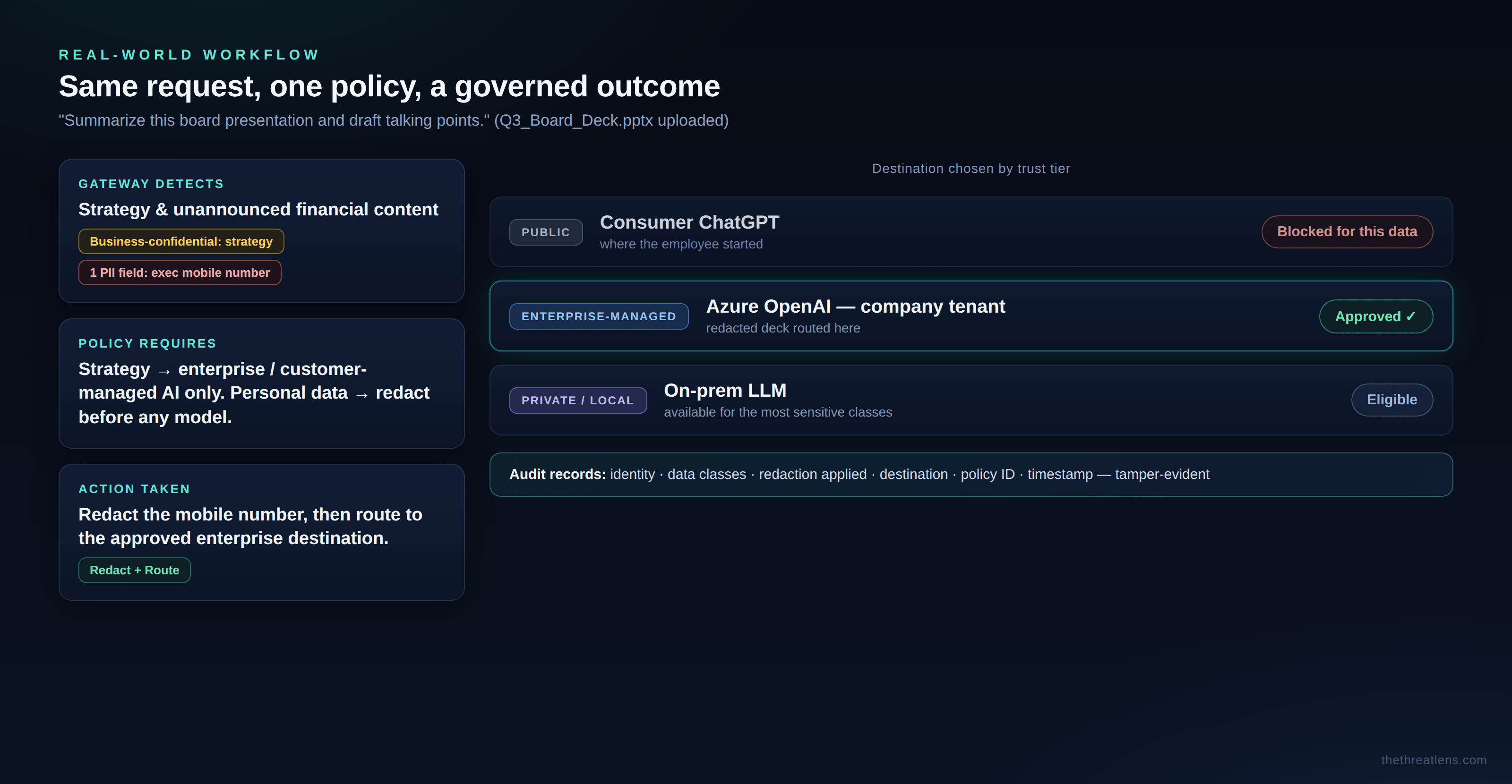
- Employee asks"Summarize this board presentation and draft talking points." (uploads Q3_Board_Deck.pptx)
- Gateway detectsstrategy + unannounced financial content, one PII field (a named exec's personal mobile in the appendix).
- Policy requiresstrategy and financial-planning content -> enterprise-managed or customer-managed AI only; personal data -> redact before any model.
- Action takenredact the personal mobile number, then route the deck to the approved Azure OpenAI destination in the company tenant instead of the public tool the employee started from.
- User seesa short banner: "Routed to approved enterprise model; 1 value redacted," then the summary and talking points.
- Audit recordsuser identity, data classes detected, redaction applied, destination chosen, policy ID, and timestamp, as a tamper-evident entry.
One policy, three outcomes by trust tier: the public tool is blocked for this data, the redacted deck is routed to the approved enterprise model, and everything is recorded for audit.
The employee still gets the summary. The strategy content never touches a consumer service. The personal data never reaches any model. And the organization has an evidence record it can hand to an auditor. That is the difference between blocking AI and governing it.
The AI Gateway is often confused with infrastructure enterprises already run. The graphic below summarizes where it sits relative to the controls it is most often mistaken for; the sections that follow go one comparison at a time.
How the AI Gateway compares to the API gateway, secure web gateway, and CASB most enterprises already operate.
AI Gateway vs LLM Gateway
These two terms describe the same category from different angles, and buyers search for both. "LLM gateway" grew out of the developer and platform world, where the first problem was operational: how to put a single, consistent endpoint in front of many model providers so applications could route across them, control token cost, cache responses, and fail over. "AI Gateway" is the broader label that keeps all of that but adds the governance, data-protection, and audit responsibilities an enterprise needs, and it stretches beyond text LLMs to embeddings, multimodal models, and tool-using agents.
In practice, treat them as the same product with different emphasis. If a vendor sells an "LLM gateway" that only routes and meters, ask where the classification, enforcement, and audit live before you rely on it for governance.
AI Gateway vs API Gateway
An API gateway manages traffic between services. An AI Gateway governs the content and destination of AI interactions. They overlap in that both are chokepoints with auth and rate limiting, but they optimize for different things.
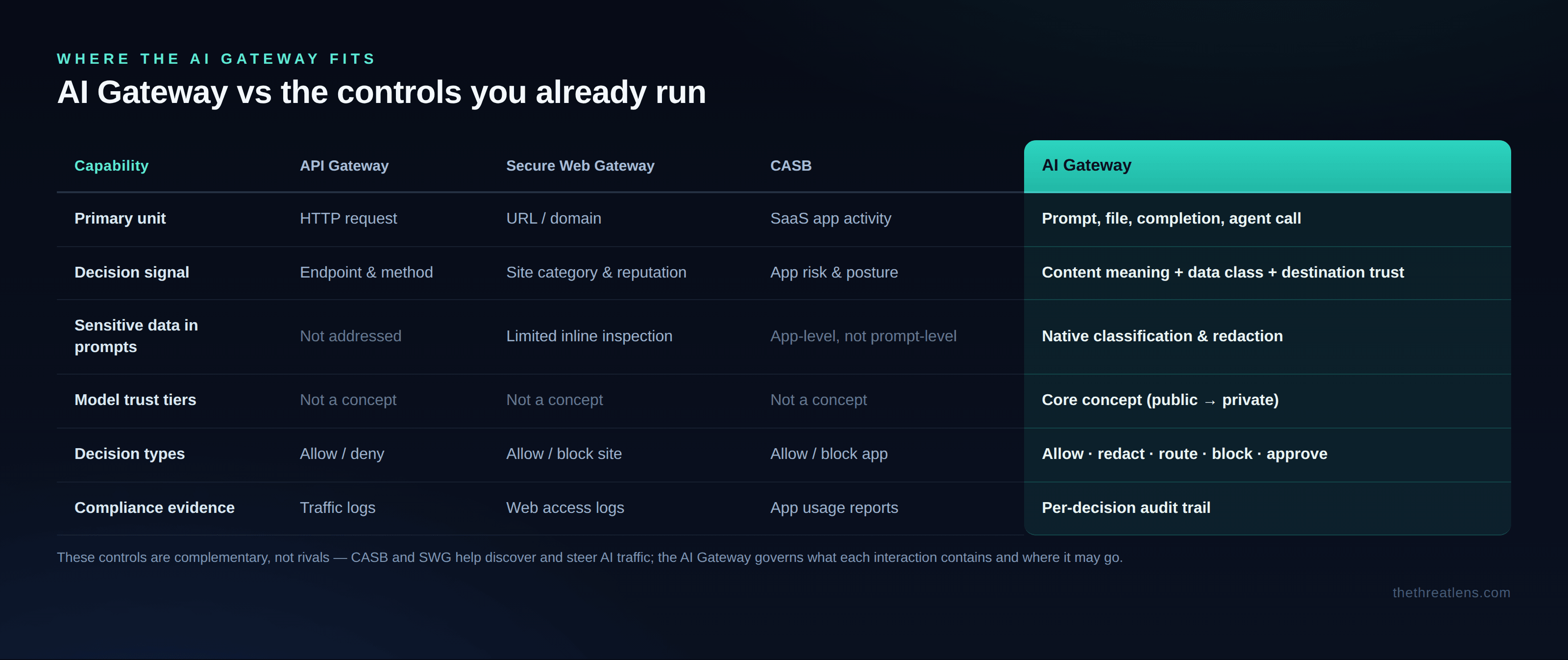
Most enterprises end up running both, layered: the API gateway handles conventional service traffic; the AI Gateway handles inference, streaming, cost, and governance.
AI Gateway vs Secure Web Gateway (SWG)
A secure web gateway inspects and filters web traffic by destination, category, and threat. It is good at "should this user reach this site." It is weak at "what is inside this prompt and where should this specific content be allowed to go."
An SWG can be part of the enforcement fabric, it is a natural place to steer browser AI traffic toward the gateway, but on its own it forces the blunt choice between blocking a useful tool and allowing everything through it.
AI Gateway vs CASB
A cloud access security broker discovers and governs SaaS usage, including which AI tools employees have adopted. It answers "which AI services are in use and by whom." An AI Gateway answers "what is in each interaction and what should happen to it."
The two are complementary. CASB is often how a program discovers its AI footprint; the AI Gateway is how it governs the traffic once discovered.
AI Gateway vs AI DLP
This comparison causes the most confusion, because the functions overlap. The cleanest way to think about it: AI DLP is a capability; an AI Gateway is where that capability is enforced inline, alongside routing, trust tiering, and audit.
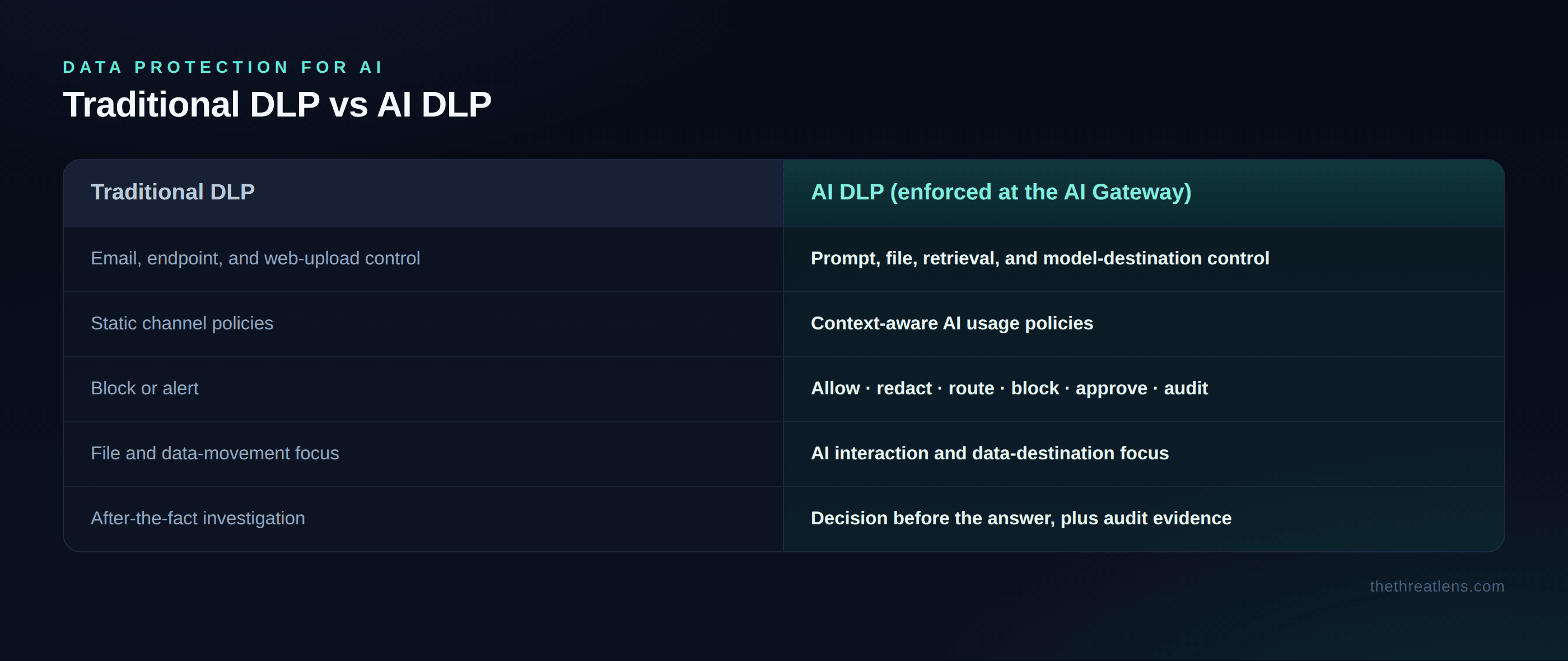
AI DLP is the discipline of protecting sensitive data in AI workflows. Unlike traditional DLP, it cannot be framed as simple blocking. Enterprise AI DLP must support a spectrum of decisions, allow, redact then send, route to a more trusted destination, block forbidden content, and log the full governance decision for audit. It has to apply the same outcome to the same data whether that data is typed, pasted, uploaded, or retrieved from enterprise knowledge.
Traditional DLP guards files and channels; AI DLP, enforced at the gateway, guards prompts, retrieval, and model destinations with a full spectrum of outcomes.
An AI Gateway without strong AI DLP is a fast, well-instrumented pipe with weak protection. AI DLP without a gateway to enforce it is a policy with no reliable chokepoint. Enterprises want them together: the gateway as the control point, AI DLP as the logic that decides what happens to the data flowing through it.
AI Gateway vs AI Firewall
"AI firewall" usually refers to a control focused on the model-security threats in application traffic: prompt injection, jailbreaks, malicious or unsafe outputs, and abuse of tool-using agents. It is often framed around protecting an AI application from attackers and protecting users from harmful model output.
The practical view is that AI firewall capabilities — input threat inspection and prompt-injection defence — are a subset of what an enterprise AI Gateway does. You would not deploy them as a rival to the gateway; you would expect them to live inside it.
AI Gateway Use Cases
The category earns its keep across several concrete jobs.
Governing employee AI use. The broadest use case: putting a control point in front of ChatGPT, Claude, Gemini, Copilot, and the long tail of AI-enabled SaaS so that everyday productivity use is allowed under policy, with sensitive content redacted, routed, or blocked as the policy requires.
Securing internal AI applications. For applications your teams build on model APIs, the gateway inspects inputs for injection and enforces which data classes may reach which models.
Controlling cost and reliability. A single chokepoint is where you meter token spend, enforce per-team budgets, cache semantically equivalent requests, and fail over across providers so one vendor outage does not stop the business.
Producing governance evidence. The gateway is the system of record for AI decisions, which is what compliance and audit functions increasingly need.
Four platform-specific use cases deserve their own note, because they are what most enterprise programs ask about first.
AI Gateway for ChatGPT. Consumer and enterprise ChatGPT are the most common shadow-AI destination. A gateway lets you allow ChatGPT for general use while inspecting prompts and uploads, redacting regulated data, and routing anything touching your most sensitive classes to an enterprise-tenant or private model instead. The alternative, a blanket block, simply moves the usage to personal devices.
AI Gateway for Microsoft Copilot. Copilot's risk profile is different: it is inside your tenant, retrieving across SharePoint, OneDrive, and Exchange. The governance concern is less about egress to a third party and more about what Copilot retrieves and surfaces, so the primary control here is Microsoft's own stack rather than a third-party proxy. Microsoft Purview provides the native governance layer: sensitivity labels that stop Copilot from returning content a user lacks rights to (label-based encryption requires the EXTRACT usage right for an AI app to use the data), Data Loss Prevention with a dedicated "Microsoft 365 Copilot and Copilot Chat" policy location that can exclude labeled files from processing, Data Security Posture Management (DSPM) for AI to surface oversharing risk, and unified audit logging of prompts and responses. An external AI Gateway complements this by governing the other Copilot-adjacent paths, the public chatbots and third-party AI tools employees use alongside Copilot, and by applying one consistent policy across both. For this reason, Copilot governance usually requires both Microsoft-native controls and broader AI governance for the surrounding AI ecosystem. Microsoft 365 administrators are usually the ones who feel this split first.
AI Gateway for Azure OpenAI. Azure OpenAI is a common approved destination, an enterprise-managed tier in your own cloud tenant. The gateway's job is to route qualifying traffic to it, enforce which data classes are permitted, and meter usage, so that Azure OpenAI becomes the governed landing spot for content too sensitive for public tools.
AI Gateway for AWS Bedrock. Bedrock plays the same role in AWS environments: a customer-managed, in-account model destination. A gateway routes to Bedrock under policy, applies data protection on the way in, and records the decision, giving regulated workloads a governed path to capable models without leaving the account boundary.
AI Gateway Security
Governance is the reason enterprises adopt an AI Gateway, but security is what makes the governance trustworthy. A gateway that can be bypassed, blinded, or manipulated is not a control. Several security functions have to work together for the gateway to earn its place as the chokepoint for AI traffic.
Prompt inspection is the foundation. The gateway reads the actual content of each prompt, attachment, and retrieved context rather than treating the request as an opaque blob. This is what makes every downstream decision possible: you cannot classify, redact, or route what you have not inspected. Inspection must cover multimodal inputs, documents, images, transcripts, because sensitive data does not only arrive as plain text.
Prompt injection protection addresses the top risk in the OWASP Top 10 for LLM Applications. Injection attempts try to override an application's instructions through crafted input, whether typed directly or hidden inside a retrieved document or web page. The gateway inspects inputs for known injection patterns and suspicious instruction-like content, and, for applications that use tools or agents, constrains what those systems are permitted to do, reducing the excessive agency that turns an injection into an action. No filter eliminates injection entirely, so this is a strong layer, not a guarantee.
AI DLP is the data-protection core, and at the gateway it is enforced inline rather than investigated after the fact. It classifies content against the data classes the enterprise cares about, personal data, payment data, health information, source code, secrets, and business-confidential categories, and acts on the result with the full spectrum of outcomes: allow, redact then send, route to a more trusted destination, or block. The same data receives the same outcome whether it is typed, pasted, uploaded, or retrieved from enterprise knowledge.
Input inspection and classification do the heavy lifting. The gateway reads the actual content of prompts, files, and retrieved context before a request reaches a model, so sensitive data is caught at the point it would otherwise leave, not discovered after the fact. Prompt exposure and document upload, both named risks in the OWASP list, are handled before anything reaches the provider.
Model routing is a security control as much as an operational one. By routing each request to an approved destination based on the data it contains, the gateway keeps sensitive classes away from untrusted models and steers them to enterprise- or customer-managed ones. Failover across providers also protects availability, so a single vendor outage does not force users back to ungoverned tools.
Trust tiers give routing its meaning. Classifying destinations by how much you trust them with your data, public consumer models, enterprise-managed models under contract, customer-managed models in your own cloud, and private or local models, lets one policy produce different, defensible outcomes for the same data class depending on where it is headed. This is the mechanism that lets an enterprise enable AI broadly while still protecting its most sensitive content.
Audit logging is the security function that makes all the others provable. Every decision, the identity, the data classes detected, the action taken, the destination, the policy that applied, and the timestamp, is written to a tamper-evident record. This is what turns AI security from a set of assertions into evidence you can hand to an incident responder or an auditor. Because the log itself can accumulate sensitive prompts, it deserves the same access control, minimization, and retention discipline as the traffic it records.
Together these functions describe why an AI Gateway is a security platform, not a networking convenience. Inspection makes decisions possible, DLP and injection protection make them safe, routing and trust tiers make them proportionate, and audit makes them provable.
Best Practices
Start in monitor mode, not enforcement. Put the gateway inline to observe and classify before it blocks anything. You will learn what your AI traffic actually looks like, and you will avoid the credibility damage of a noisy rollout that blocks legitimate work on day one.
Define data classes before policies. Policy is only as good as the classification underneath it. Agree on the handful of data classes that matter, personal, payment, health, source code, secrets, and your business-confidential categories, before writing rules.
Build a trust matrix, not a block list. Decide, for each data class, which model tiers are acceptable: public, enterprise-managed, customer-managed, private. This is what lets you enable AI broadly while still protecting the few classes that need it.
Prefer redaction and routing over blocking. A block is a productivity cost and a signal to route around you. Redacting sensitive values or routing to a more trusted model preserves the work while removing the risk. Reserve hard blocks for genuinely forbidden content.
Make the decision visible to the user. Showing the governance outcome inline builds trust and teaches good behavior. Silent controls breed suspicion and workarounds.
Treat outputs as seriously as inputs. Leakage, injection artifacts, and system-prompt disclosure appear in completions. Inspect them.
Design for exceptions. Ambiguous or high-stakes requests need a defined path — a more trusted destination or a block — rather than a policy that is either too permissive or too strict.
Instrument everything for audit from the start. If the log is not tamper-evident and complete, you will regret it during your first incident or audit.
Common Mistakes
The most common failure is leading with blocking. Programs that open by denying popular tools lose the organization's goodwill and push usage underground, where there is no visibility at all.
The second is treating the AI Gateway as pure infrastructure. Teams deploy it for routing and cost, enjoy the dashboards, and never turn on the governance that was the point. The plumbing is necessary but not sufficient.
The third is inconsistent coverage across input paths. Governing typed prompts but not uploads, or browser use but not application traffic, leaves the same data ungoverned through a different door. The whole value depends on the same outcome applying regardless of how the data arrives.
The fourth is over-relying on regular expressions. Structured identifiers like card numbers match well; strategy documents, legal text, and source code do not. Classification needs context, not just patterns.
The fifth is forgetting the audit trail. A gateway that enforces but does not produce clean, complete, tamper-evident evidence solves the security problem and leaves the compliance problem wide open.
Compliance and Audit Considerations
An AI Gateway is, among other things, a compliance instrument. It is the place where AI data flows become observable and where governance becomes evidence.
Map the gateway's controls to the frameworks your organization answers to. The EU AI Act takes a risk-based approach, placing documentation, risk management, and transparency obligations on higher-risk AI systems. ISO/IEC 42001 defines a certifiable AI management system, the management-system model familiar from ISO 27001, applied to AI, with expectations around policy, roles, risk treatment, and continual improvement. The NIST AI Risk Management Framework organizes AI risk work around four functions, Govern, Map, Measure, and Manage, that run from setting the governance culture through identifying context, assessing risk, and acting on it. A gateway that classifies data, enforces policy, and logs every decision produces artifacts that feed all three: it supports the "Manage" and "Measure" functions of the NIST framework with concrete control and monitoring evidence, gives an ISO/IEC 42001 management system operational records of enforcement, and provides the EU AI Act's documentation and human-oversight expectations with a per-interaction trail of what data reached which systems, what controls applied, and how exceptions were handled. Treat these as operational mappings and confirm the precise obligations that apply to your systems with your own compliance function; the framework texts are the authority, not this article.
Data-protection regimes are the sharper edge. Where GDPR, HIPAA, PCI DSS, or sector rules like DORA and NIS2 apply, the gateway's job is to prevent regulated data from reaching a destination that is not permitted for it, and to prove that it did. The audit record, data class, action, destination, policy, identity, and timestamp per interaction, is the difference between asserting compliance and demonstrating it.
Two practical cautions. First, this is guidance on operational mapping, not legal advice; confirm your obligations with counsel and your auditors. Second, resist the urge to over-collect. The audit log itself can become a store of sensitive prompts, so retention, access control, and minimization on the log deserve the same care as the traffic it records.
Implementation Roadmap
A realistic rollout moves in stages, each of which builds trust for the next.
Stage 1, Discover (weeks 1, 2). Find where AI is already used: which tools, which teams, which applications call model APIs. CASB, proxy logs, and expense data all help. The output is an honest map of your AI footprint, including the shadow AI.
Stage 2, Define (weeks 2, 4). Agree on the data classes that matter and the model trust tiers you will recognize. Draft the first version of the policy and trust matrix. Keep it small and defensible.
Stage 3, Monitor (weeks 4, 8). Put the gateway inline in observe-only mode. Classify real traffic, measure how often each data class appears and where it is heading, and tune classification against reality. Do not block yet.
Stage 4, Enforce gradually (weeks 8, 12). Turn on redaction and routing first, since they preserve work. Introduce hard blocks only for clearly forbidden content. Expand from a pilot group to the organization as confidence grows.
Stage 5, Operate and prove (ongoing). Review policy against new tools and new risks, feed the audit trail into compliance reporting, and widen the list of approved destinations as the business adopts more AI.
The through-line is monitor before enforce, and enable before block. A program that follows that order tends to earn the standing it needs to tighten controls later; one that inverts it usually stalls.
Frequently Asked Questions
What is an AI Gateway in simple terms? It is a control point that sits between enterprise users and applications and the AI models they use. Every prompt passes through it, and it inspects the content, applies policy, routes to an approved model, redacts or blocks sensitive data, and logs what it decided.
Is an AI Gateway the same as an LLM gateway? The terms are used interchangeably. "LLM gateway" tends to emphasize the model-routing and cost-management side; "AI Gateway" is the broader term that also covers governance, data protection, and audit. In an enterprise context, treat them as the same category.
Do I need an AI Gateway if I already have a DLP tool? Usually yes. Traditional DLP was built for files and channels like email and endpoints, and it typically does not inspect prompts or understand model trust tiers. AI DLP is best enforced at an AI Gateway, where it can act on prompts, uploads, and destinations in real time.
How is an AI Gateway different from an API gateway? An API gateway routes and secures service traffic by request and endpoint. An AI Gateway governs the content and destination of AI interactions, prompts, completions, data classes, and model trust, with decision types beyond allow/deny, including redact and route.
Does an AI Gateway replace my secure web gateway or CASB? No. An SWG steers and filters web traffic and CASB discovers SaaS usage; both are useful and complementary. The AI Gateway adds prompt-level classification, model trust tiering, and AI-specific enforcement that neither provides on its own.
Will an AI Gateway slow down my users? Well-designed gateways add modest latency and are streaming-native, so responses still stream token by token. The governance decision happens inline in the same round trip. Semantic caching can actually speed up common requests.
Can an AI Gateway stop prompt injection? It can meaningfully reduce it. Input inspection catches many injection attempts, and least-privilege limits what a hijacked prompt can reach. No control eliminates the risk entirely; the gateway is a strong layer, not a guarantee.
How does an AI Gateway handle ChatGPT specifically? It lets you allow ChatGPT for general use while inspecting prompts and uploads, redacting regulated data, and routing your most sensitive content to an enterprise or private model instead, a middle path between banning it and allowing everything.
Does it work with Microsoft Copilot? Copilot's risk is mostly internal retrieval rather than external egress, and Microsoft governs it natively through Purview, sensitivity labels, DLP with a dedicated Copilot policy location, DSPM for AI, and unified audit logging. An external AI Gateway complements that by governing the public chatbots and third-party AI tools employees use alongside Copilot, so one consistent policy covers both the in-tenant assistant and everything around it.
Where do Azure OpenAI and AWS Bedrock fit? Both are common approved destinations, enterprise- or customer-managed model tiers inside your own cloud. The gateway routes qualifying traffic to them under policy, which is how sensitive workloads get a governed path to capable models without leaving your boundary.
What is a model trust tier? It is a classification of AI destinations by how much you trust them with your data: public consumer models, enterprise-managed models under contract, customer-managed models in your own cloud, and private or local models. Policy allows different data classes to reach different tiers.
What should an AI Gateway log? At minimum, per interaction: the identity, the data classes detected, the action taken (allow/redact/route/block), the destination, the policy that applied, and the timestamp, stored in a tamper-evident way.
How long does it take to deploy one? A staged rollout, discover, define, monitor, then enforce, commonly spans about three months to reach broad enforcement, though a monitor-mode pilot can be running in a few weeks.
Is an AI Gateway only for large enterprises? No, but the value scales with AI footprint and regulatory exposure. Any organization with meaningful sensitive data and growing AI use benefits from a single governed control point.
Does an AI Gateway block AI usage by default? It should not. The better philosophy is to enable most usage under policy and reserve blocking for genuinely forbidden content, using redaction and routing to protect data while preserving the work.
Key Takeaways
An AI Gateway is the control point for enterprise AI traffic: it inspects prompts and files, classifies data, applies policy against a model trust matrix, and records every decision. It exists because AI created a high-volume data channel that firewalls, SWGs, CASB, and legacy DLP were not built to govern. Its defining move is a spectrum of outcomes, allow, redact, route, block, and always log, which is what lets an enterprise enable AI broadly instead of blocking it. It is distinct from an API gateway (which routes services), overlaps with and enforces AI DLP, and absorbs AI firewall functions as a subset. The best programs deploy it in monitor mode first, lead with enablement, and treat the audit trail as a first-class deliverable.
Conclusion
The enterprises that handle AI well will not be the ones that blocked it longest. They will be the ones that put a control point in the middle early, learned what their AI traffic actually contained, and governed it with a light enough touch that people kept using the sanctioned path. An AI Gateway is that control point.
If you are starting, the sequence is straightforward even if the work is not. Identify where AI is used across your organization, including the shadow AI. Define the handful of data classes that genuinely matter and the model trust tiers you will recognize. Stand the gateway up in monitor mode and let it show you the truth of your traffic. Then move to enforcement, leading with redaction and routing and reserving blocks for the content that truly must not leave. Test the policies before you tighten them, and keep the audit trail clean enough to hand to an auditor without preparation.
Do that, and AI adoption stops being a standoff between speed and safety. It becomes a governed capability the business can grow on purpose.
Where ThreatLens Fits
ThreatLens Governance operationalizes the AI Gateway pattern as part of a broader Enterprise AI Control Plane, a sovereign layer for governing how an organization adopts and uses AI.
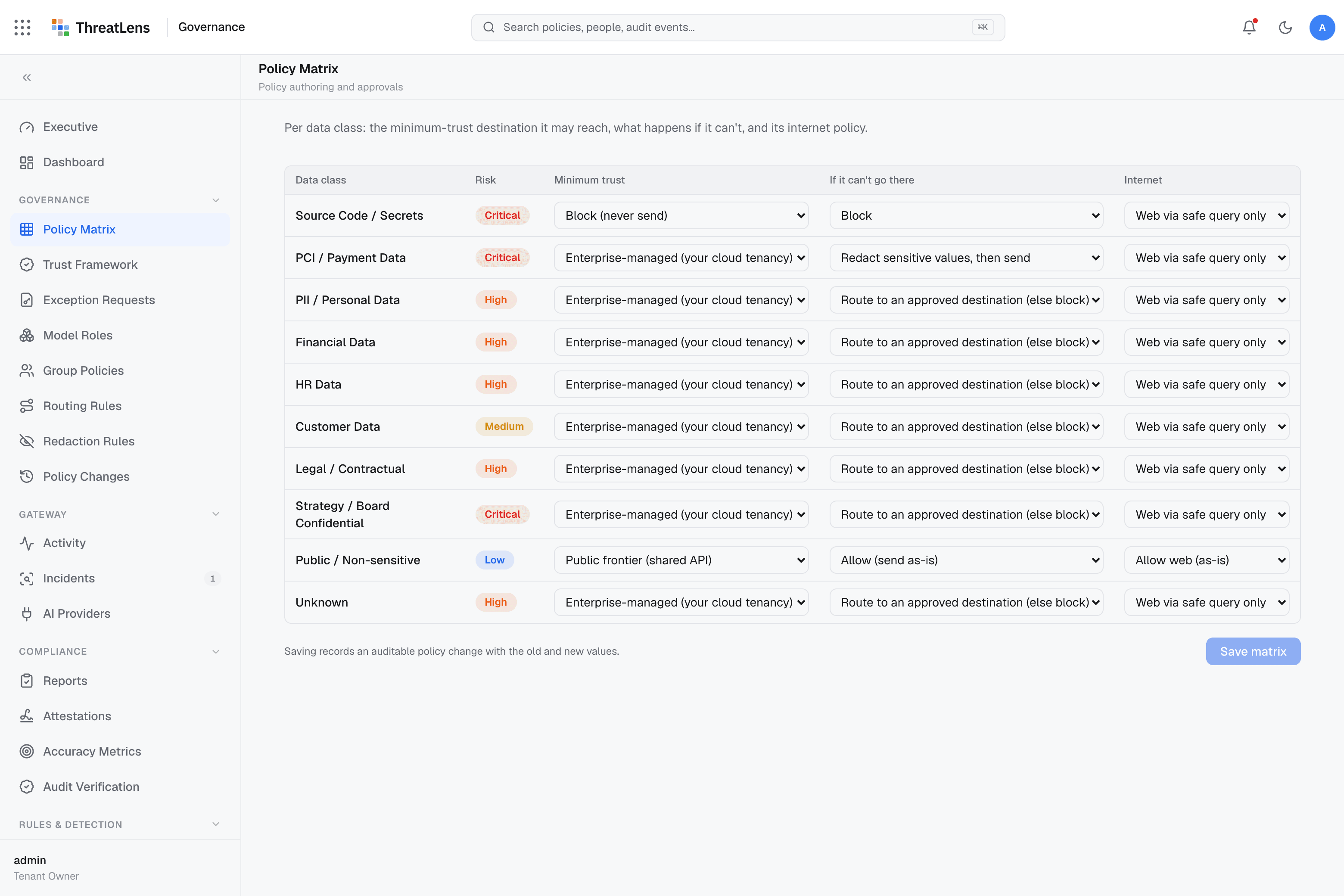
In practice, that means a governed AI workspace and gateway where prompts, files, and retrieved context are inspected and classified before they reach a model; a policy and trust matrix that maps data classes to approved destinations across public, enterprise-managed, customer-managed, and private tiers; and AI DLP that can allow, redact, route, or block rather than simply denying. Decisions are shown to the user before the answer, so governance is transparent instead of hidden, and every decision is written to a tamper-evident audit log that captures the classification, action, destination, policy, and time.
The philosophy behind it is the one this guide argues for: most AI usage should be governed and enabled, not blocked by default. The point of the control plane is to let an enterprise say yes to AI safely, routing sensitive work to approved models like an in-tenant Azure OpenAI or in-account AWS Bedrock deployment, redacting what should never leave, and keeping the evidence that proves it, so adoption can move quickly without trading away control.
If AI governance is on your roadmap, the concrete next step is not a product decision. It is to map your AI usage channels, define your data classes and approved destinations, run a period in monitor mode, and move toward enforcement once your policies have been tested against real traffic. A control plane like ThreatLens is how you carry that from plan into daily operation.
Related reading: What Is AI Governance? · What Is AI DLP? · What Is Shadow AI? · Enterprise AI Security Best Practices · How to Prevent ChatGPT Data Leakage · Enterprise AI Workspace · AI Policy Matrix · AI Governance Maturity Model