
Introduction
Somewhere in your organization right now, an employee is pasting something sensitive into an AI tool you have never heard of. A developer is asking a public chatbot to fix a stack trace that includes internal code. An analyst is summarizing a board deck in a browser tab. A recruiter is uploading a stack of CVs to an AI assistant to "score" them. None of these people are trying to breach policy. They are trying to finish their work faster.
That is why Shadow AI has become one of the fastest-growing enterprise security and governance challenges, not because employees are malicious, but because AI has become indispensable to modern work.
This is Shadow AI: the everyday, unsanctioned use of AI tools inside a company, happening outside the visibility and control of security, IT, and compliance. It is the AI-era successor to Shadow IT, and it is spreading faster than most governance programs can move.
The instinct for many security teams is to ban it. That instinct is understandable and, in almost every case, counterproductive. This article explains what Shadow AI actually is, why it exists, why it is growing, the business, security, and compliance risks it creates, and, most importantly, how to bring it under control without killing the productivity that is driving it. The through-line is simple: you do not beat Shadow AI by prohibition. You beat it by making the governed path easier than the unsanctioned one.
This is written for the people who own that problem, CISOs, CIOs, Heads of AI, security architects, compliance and risk leaders, IT managers, and the Microsoft 365 administrators who quietly run half of the stack.
What Is Shadow AI?
Shadow AI is the use of artificial intelligence tools, models, and features by employees without the approval, visibility, or governance of the organization. It covers public chatbots, AI features embedded in SaaS products, browser extensions, personal AI accounts used for work, and AI coding assistants, anything where company data meets a model that security and compliance did not sanction and cannot see.
It is worth being precise, because "Shadow AI" gets used loosely. Three characteristics define it:
- Unsanctioned. The tool or usage pattern was never approved through a governance process. It may be explicitly against policy, or simply never considered.
- Invisible. The organization has no reliable record of who is using it, with what data, or how often. Traditional monitoring does not see it.
- Ungoverned. No policy is enforced at the point of use. Nothing classifies the data, decides whether it should go, or records what happened.
Shadow AI is the natural extension of Shadow IT, the long-standing pattern of employees adopting unapproved software and cloud services. What makes the AI version sharper is the nature of the interaction: it is what employees say to a model, not just where they store a file.
Shadow AI vs Shadow IT
Although the terms sound similar, they describe different problems.
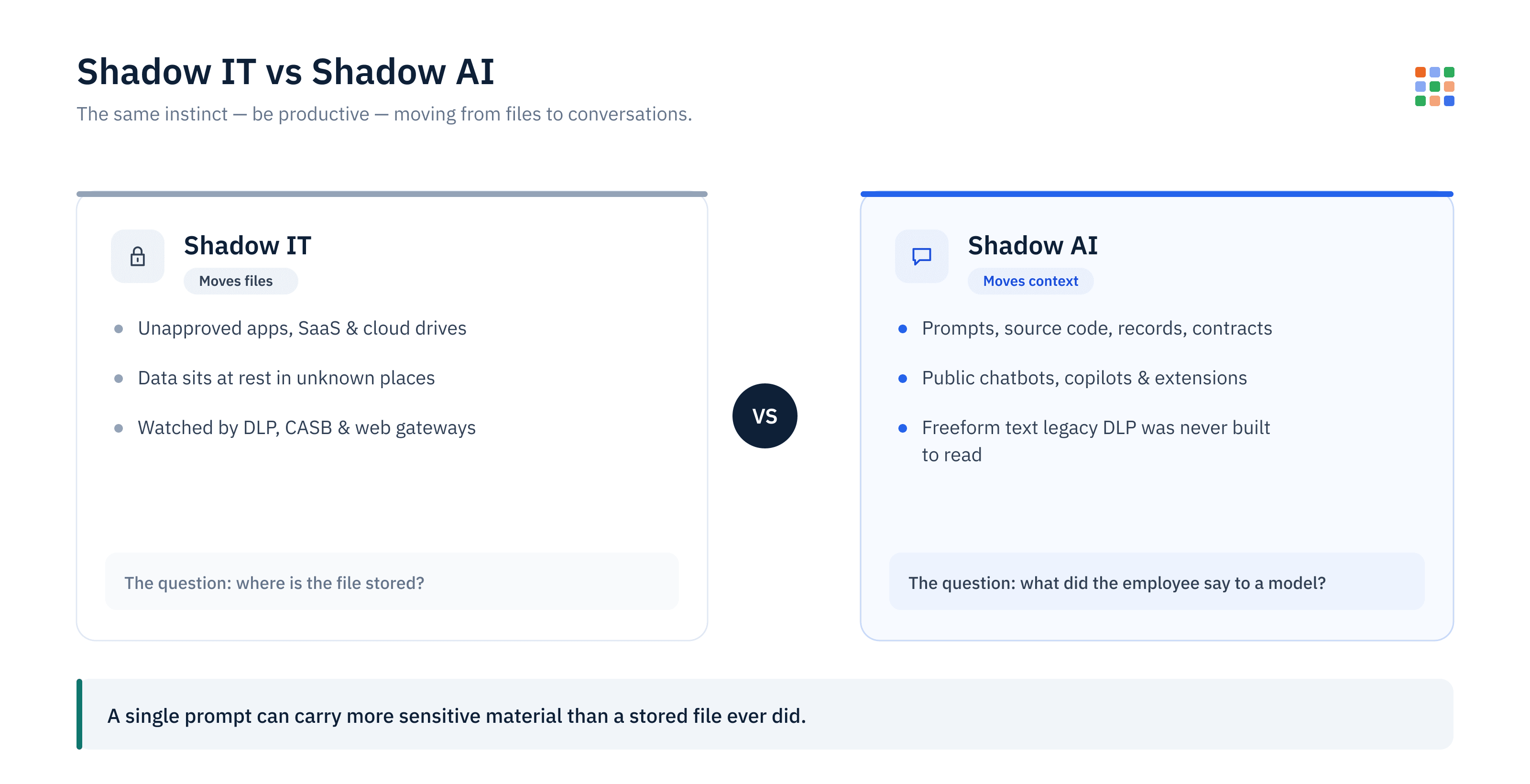
Shadow IT refers to employees using unapproved software or cloud services outside IT oversight, a file-sharing tool, an unsanctioned SaaS app, a personal cloud drive. Shadow AI refers specifically to employees using AI models, assistants, copilots, browser extensions, and embedded AI features without enterprise governance.
The key difference is that Shadow AI is conversation-driven. Instead of moving files, employees now move context, prompts, documents, source code, customer records, contracts, and strategic information, into AI systems. A single prompt can carry more sensitive material than a stored file ever did, and it does so in freeform text that traditional tools were never built to read. That makes governance significantly more challenging than traditional Shadow IT, and it is why controls designed for file movement miss the AI channel entirely.
Why Shadow AI Exists
Shadow AI is not primarily a discipline problem. It is a structural one, and it exists for reasons that predate AI.
The tools are extraordinarily useful and instantly available. A capable AI assistant is one browser tab away, free, and requires no procurement, no ticket, and no training. The barrier to adoption is effectively zero.
Enterprise AI adoption is already mainstream. In McKinsey's 2025 State of AI survey, 78% of organizations reported using AI in at least one business function, and 71% said they regularly use generative AI, up from 65% in early 2024 (McKinsey). When the technology is that widespread, individual employees adopt it whether or not a program exists to guide them.
The approved path is usually slower, or absent. Most organizations have not yet delivered a sanctioned, governed way to use AI that is as fast and capable as the public tools. When the only official answer is "don't," employees route around it. Every time governance is slower than the shadow option, the shadow option wins.
AI is embedded everywhere. Even organizations that block ChatGPT find AI features inside the SaaS tools they already pay for, the note-taker in the meeting app, the summarizer in the CRM, the assistant in the document editor. Shadow AI is not only standalone chatbots; it is a long tail of embedded features that arrived without anyone deciding to "adopt AI."
The result is that adoption has outrun governance. And the data that flows through this gap is not trivial: analysis of real enterprise usage by Cyberhaven found that the share of corporate data going into AI tools that was sensitive rose to 27.4% in early 2024, while the total volume of corporate data entering AI tools grew 485% year over year (Cyberhaven).
Common Examples of Shadow AI
Shadow AI is easiest to understand through the everyday scenarios where it happens. None of these involve bad actors. All of them are common.
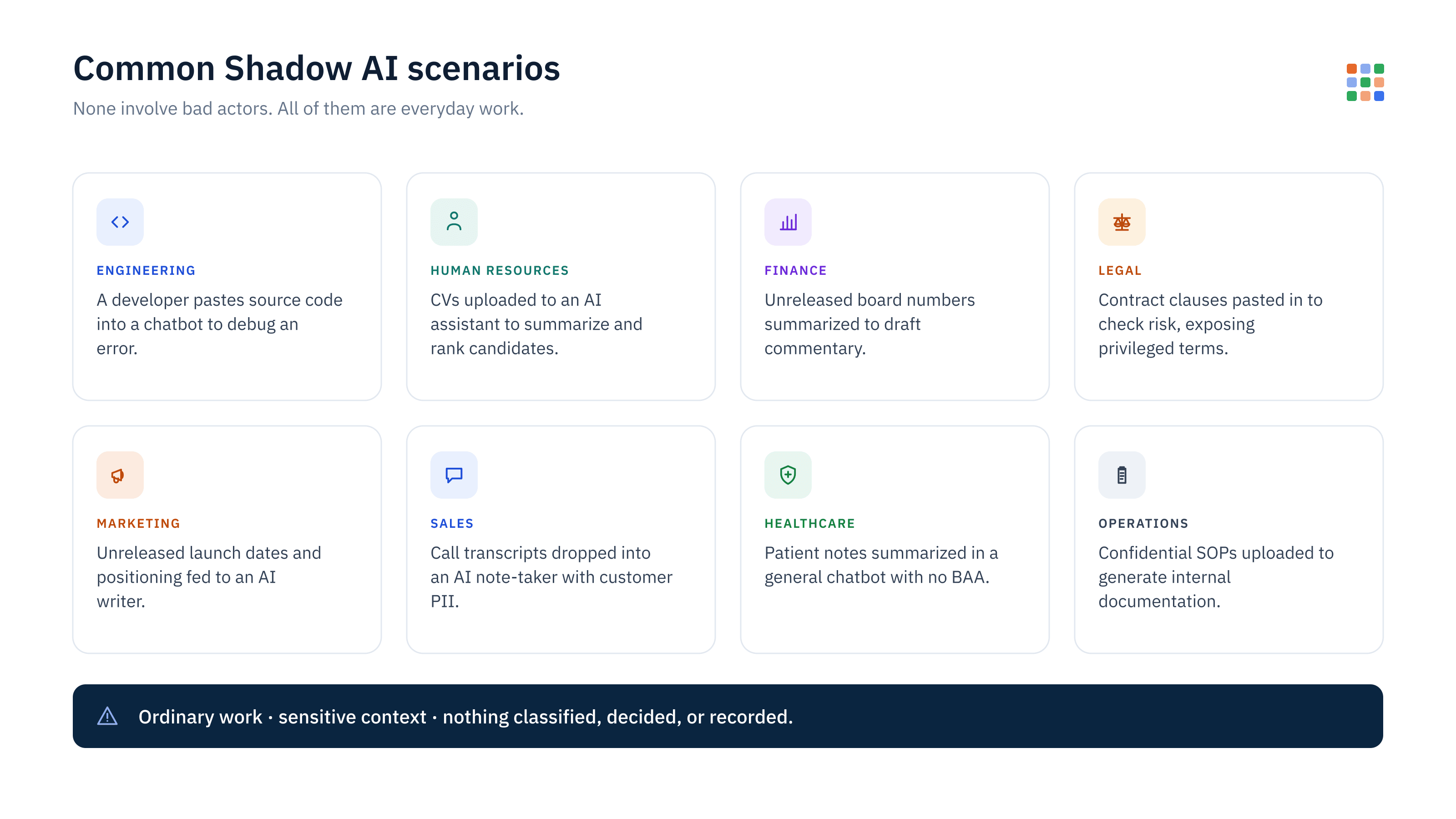
- A developer pastes source code into ChatGPT to debug an error or refactor a function. Proprietary logic and internal identifiers leave with it.
- HR uploads CVs to an AI assistant to summarize or rank candidates. Résumés are dense with personal data, and the ranking itself may raise fairness and regulatory questions.
- Finance summarizes board reports and unreleased numbers in a public chatbot to draft commentary, material, non-public information in a third-party tool.
- Legal reviews contracts by pasting clauses into an AI tool to check risk, potentially exposing privileged and confidential client or counterparty terms.
- Marketing generates campaign copy using an AI writer, feeding it unreleased product details, positioning, and launch dates.
- Sales summarizes customer meetings by dropping call transcripts into an AI note-taker, moving customer PII and deal specifics outside controlled systems.
- Healthcare staff summarize patient notes in a general-purpose chatbot, placing protected health information into a tool with no BAA and no safeguards.
- University researchers use public AI on unpublished findings or datasets, risking research IP and, where applicable, export-controlled or personal data.
- Operations uploads confidential SOPs to an AI tool to generate internal documentation, standard operating procedures, runbooks, and process descriptions that map exactly how the business runs.
Across all of these, the pattern is identical: sensitive context enters a prompt or an upload, the model returns something genuinely useful, and no one classified the data, decided whether it was allowed, or recorded that it happened.
Why Employees Use Unsanctioned AI
If you want to govern Shadow AI, start by understanding the person doing it, because the usual security assumption is wrong. Employees using Shadow AI are, overwhelmingly, not trying to bypass security. They are trying to be productive.
The motivations are mundane and rational:
- Speed. AI compresses tasks that used to take an hour into minutes. That is hard to refuse when you are busy.
- Quality. For drafting, summarizing, and coding, the output is often good enough to matter.
- Absence of an approved alternative. If no sanctioned tool exists, or the sanctioned one is weaker or slower, the public tool is the only practical option.
- Ambiguity. Many employees genuinely do not know that pasting a document into a chatbot is different, from a data-governance standpoint, from pasting it into a search engine.
This reframing has a direct operational consequence. If Shadow AI were driven by malice, the answer would be enforcement and deterrence. Because it is driven by productivity, the answer is a better-designed official path. People take the shortcut because the shortcut is faster. Remove the speed penalty from the governed route and the reason for the shadow route mostly disappears.
The single most important design principle in all of Shadow AI governance follows from this: the approved path must be easier than the unsanctioned path. If your governed workspace is slower, clunkier, or more restrictive than the free chatbot, employees will keep using the chatbot, and no policy memo will change that.
Business Risks
Shadow AI creates risk across three dimensions, business, security, and compliance. Start with the business impact, because it is often overlooked in favor of the security angle.
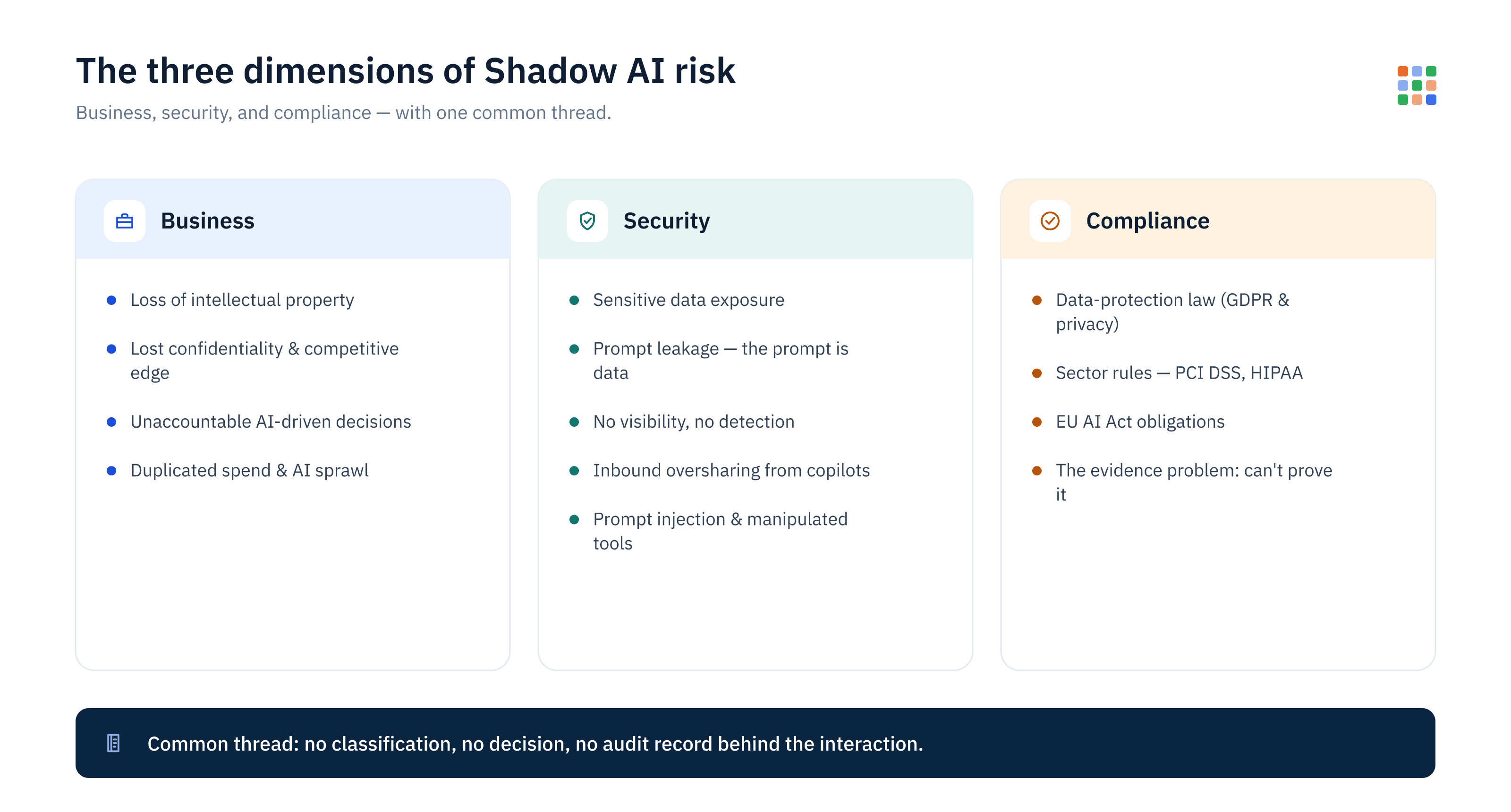
Loss of intellectual property. Source code, designs, pricing models, strategy, and unreleased plans pasted into public tools can be retained, logged, or, under some consumer terms, used to improve models. Once it leaves, you cannot pull it back.
Loss of confidentiality and competitive edge. Deal terms, M&A analysis, and product roadmaps are valuable precisely because they are private. Shadow AI quietly erodes that.
Inconsistent and unaccountable decisions. When AI output informs hiring, credit, pricing, or customer responses with no oversight, the organization inherits the consequences of decisions it never reviewed and cannot explain.
Reputational exposure. A single visible incident, a leaked document traced to a chatbot, a biased AI-driven decision, can damage customer and partner trust well beyond the direct data loss.
Duplicated and wasted spend. Ungoverned adoption means teams independently paying for overlapping AI tools, with no consolidation, no negotiated terms, and no assurance about how each vendor handles data.
Vendor lock-in and uncontrolled AI sprawl. Without governance, different teams adopt different AI platforms independently. The result is duplicated subscriptions, inconsistent security controls, and fragmented policies. Over time this becomes AI sprawl, a growing, tangled estate of tools and integrations that makes governance harder the longer it is left unaddressed, and that quietly deepens dependence on whichever vendors happened to arrive first.
Security Risks
The security risks of Shadow AI are the ones most teams think of first, and they are real, but they extend beyond simple data leakage.
Sensitive data exposure. The core risk: regulated or confidential data entering a prompt or upload and leaving your control, with unclear retention and downstream use.
Prompt leakage, the prompt itself is data. Even when no file is uploaded, prompts routinely contain customer names, project names, system architecture, credentials, business strategy, financial assumptions, and snippets of source code. You do not need to attach a document to leak sensitive information; the prompt itself can be the leak. This is exactly why governing Shadow AI means inspecting prompts, not just attachments.
No visibility, no detection. Because Shadow AI bypasses traditional monitoring, exposure happens with no alert and no record. You cannot investigate what you cannot see, and you often learn about it only after the fact, if ever.
Inbound risk from AI outputs. Risk is not only outbound. AI features that inherit a user's permissions, Microsoft Copilot is the common example, can surface data the user should not see, turning an answer into an oversharing incident.
Prompt injection and manipulated tools. As employees adopt AI assistants and agents that can act on data, hidden instructions in documents, emails, or web pages can hijack them. Prompt injection is the top entry in the OWASP Top 10 for LLM Applications (2025), which catalogues the AI-specific risks security teams now have to account for (OWASP).
Expanded, unmanaged attack surface. Every unsanctioned tool is an unvetted third party with access to whatever data employees give it, no security review, no contract, no assurance.
Compliance Risks
Shadow AI does not get a regulatory exemption. When regulated data flows into an unsanctioned tool, existing obligations still apply, you simply lose the ability to demonstrate compliance. Treat the following as practical mapping, not legal advice; confirm specifics with counsel.
Data-protection law. Personal data entering AI tools implicates regimes such as GDPR and regional privacy laws, lawful basis, data minimization, and records of processing all become questions you cannot answer if the usage is invisible.
Sector rules. Regulated sectors carry specific obligations, PCI DSS for cardholder data, HIPAA for protected health information, financial-sector and operational-resilience rules, and Shadow AI creates unmonitored paths for exactly the data those rules protect.
AI-specific regulation. The EU AI Act introduces obligations for higher-risk AI uses, with the bulk of high-risk requirements beginning to apply on 2 August 2026 and penalties that can reach 7% of global annual turnover (EU AI Act timeline). Governing which AI is used, for what, and with what data is becoming a documented expectation, not an optional one.
AI management standards and frameworks. Beyond binding law, voluntary standards set expectations that increasingly show up in enterprise contracts and audits. ISO/IEC 42001 defines an AI management system, including maintaining an inventory of AI use and controlling how data flows into it, and the NIST AI Risk Management Framework's govern/map/measure/manage functions expect the same visibility and control. Shadow AI is precisely the blind spot these frameworks are built to eliminate.
The evidence problem. The common thread across every regime is the same. Regulators and auditors increasingly ask not just "do you have a policy?" but "can you prove it was enforced?" Shadow AI makes that question unanswerable, because there is no classification, no decision, and no audit record behind the interaction.
Traditional Security Controls vs AI Governance
Most enterprises already run a mature stack, email DLP, CASB, secure web gateways, endpoint protection. These tools were built before generative AI became part of daily work, and they assume data leaves as a file, through a known channel, in a recognizable format. Shadow AI breaks all three assumptions: employees paste prompts instead of sending files, upload documents straight into tools, and reach models over ordinary encrypted web traffic. A DLP rule watching for a spreadsheet attachment never fires when the same figures are pasted into a chat box.
The gap is not a failure of the old controls; it is a new control surface they were never designed to see. Governing Shadow AI requires acting at the AI interaction itself. Put simply: traditional DLP focuses on where data moves. AI governance focuses on why it is moving, what it contains, where it is going, and whether it should go at all.
The point is not to replace the existing stack, it still covers email, endpoints, and file movement, but to add the layer that governs what employees say to AI and where it goes.
How Organizations Can Detect Shadow AI
You cannot govern what you cannot see, so detection comes first. A practical discovery program layers several signals:
- Network and proxy telemetry. Identify traffic to known AI services and domains through your secure web gateway, firewall, CASB, or Microsoft Defender for Cloud Apps to establish which tools are in use and how heavily.
- Identity and SSO signals. Review sign-ins and OAuth grants to AI applications to find sanctioned-looking and unsanctioned tools connected to corporate identities.
- Endpoint and browser signals. Detect AI browser extensions and desktop clients, and, where appropriate and disclosed, surface risky paste/upload behavior into AI domains.
- SaaS and Microsoft 365 review. Inventory the AI features already embedded in tools you own (copilots, summarizers, assistants), which are easy to overlook because no one "installed" them.
- Ask people. Anonymous surveys and team conversations consistently surface tools and use cases telemetry misses. Employees will tell you what they use if you make it safe to say so.
The goal of discovery is not a list to punish people with. It is a baseline: which tools, which teams, which data classes, and how often. That baseline is what turns Shadow AI from an unknown into a measurable, governable problem.
How Organizations Can Govern Shadow AI
Detection tells you what is happening. Governance decides what should happen, at the moment each interaction occurs, not after. Effective Shadow AI governance is not a single block; it is a graduated set of decisions applied to every AI interaction:
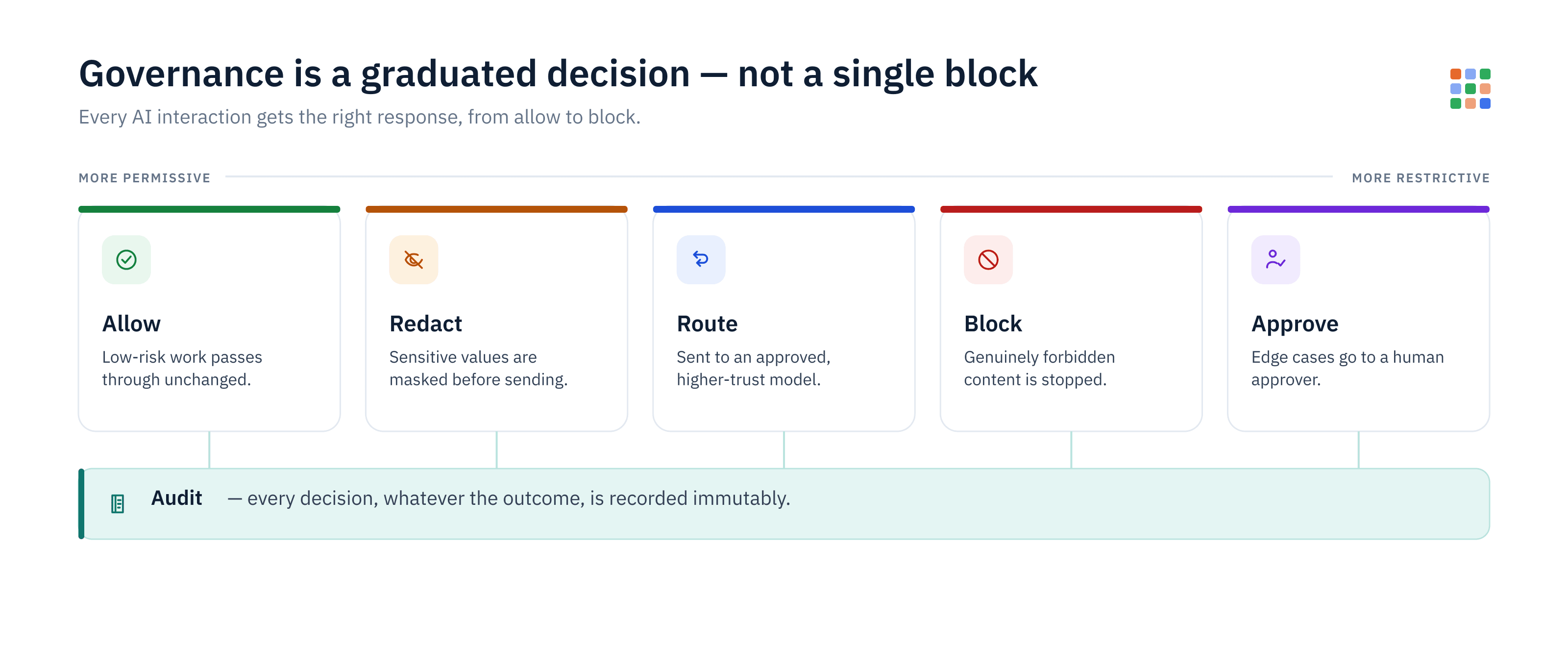
- Allow. Low-risk requests pass through unchanged, so ordinary work is never slowed.
- Redact. Sensitive values are stripped or tokenized (a customer name becomes a placeholder) and a sanitized version is sent, so the task still completes while regulated data stays inside your boundary.
- Route. Sensitive-but-permitted requests are sent to an approved, higher-trust destination, an enterprise-managed model such as Azure OpenAI or AWS Bedrock, or a private model, instead of a public tool.
- Block. Genuinely forbidden content, secrets, credentials, raw regulated data headed to public tools, is stopped, with a clear explanation so the control builds trust rather than resentment.
- Model access control. Restrict which users and groups can reach which AI models and destinations.
- Audit. Every decision is recorded immutably, turning governance into evidence.
Decision before the answer
One of the most important differences between AI governance and traditional security controls is when the decision happens. The governance decision should be made before the model processes the request, not discovered afterward in a log. When a request is allowed, routed, redacted, or blocked, the employee sees why, before the response is generated: why it was permitted, why it was sent to an approved model, why a value was masked, or why it was stopped.
That "decision before the answer" transparency changes the experience of being governed. People accept a control that explains itself in the moment far more readily than one that blocks them silently or logs them after the fact. It turns governance from an obstacle into a guardrail, and it is a large part of why a governed path can be more pleasant to use than the shadow one.
A real-world workflow
Concrete beats abstract. Here is a single interaction governed end to end:
``text Employee asks: "Summarize this board presentation." System detects: strategy and financial-planning content (sensitive). Policy requires: enterprise-managed or customer-managed AI only. Action taken: route to approved Azure OpenAI (or AWS Bedrock) destination. User sees: a governance decision shown before the answer. Audit records: classification, action, destination, policy, and timestamp. ``
The employee still gets their summary. The sensitive content never touches a public model. Security holds a record proving the control ran. No one had to choose between productivity and protection, which is the entire point.
Why banning AI backfires
It is worth stating plainly, because so many programs start here: banning AI does not remove Shadow AI, it hides it. A blanket block pushes usage onto personal devices, personal accounts, and phones, where you have no visibility at all. The data still leaves; you just stop being able to see it or prove anything about it. Prohibition also carries an opportunity cost, competitors who govern AI adoption keep the productivity you gave up.
Governance outperforms prohibition for a simple reason. Prohibition fights the employee's incentive; governance works with it. Give people a fast, sanctioned path and most of them will take it, because it is easier and they were never trying to evade you in the first place.
AI Governance Maturity Model
Most organizations can locate themselves on a simple curve. The goal is to move up it deliberately, and to recognize that the "safe-feeling" bottom rung is actually the least safe.
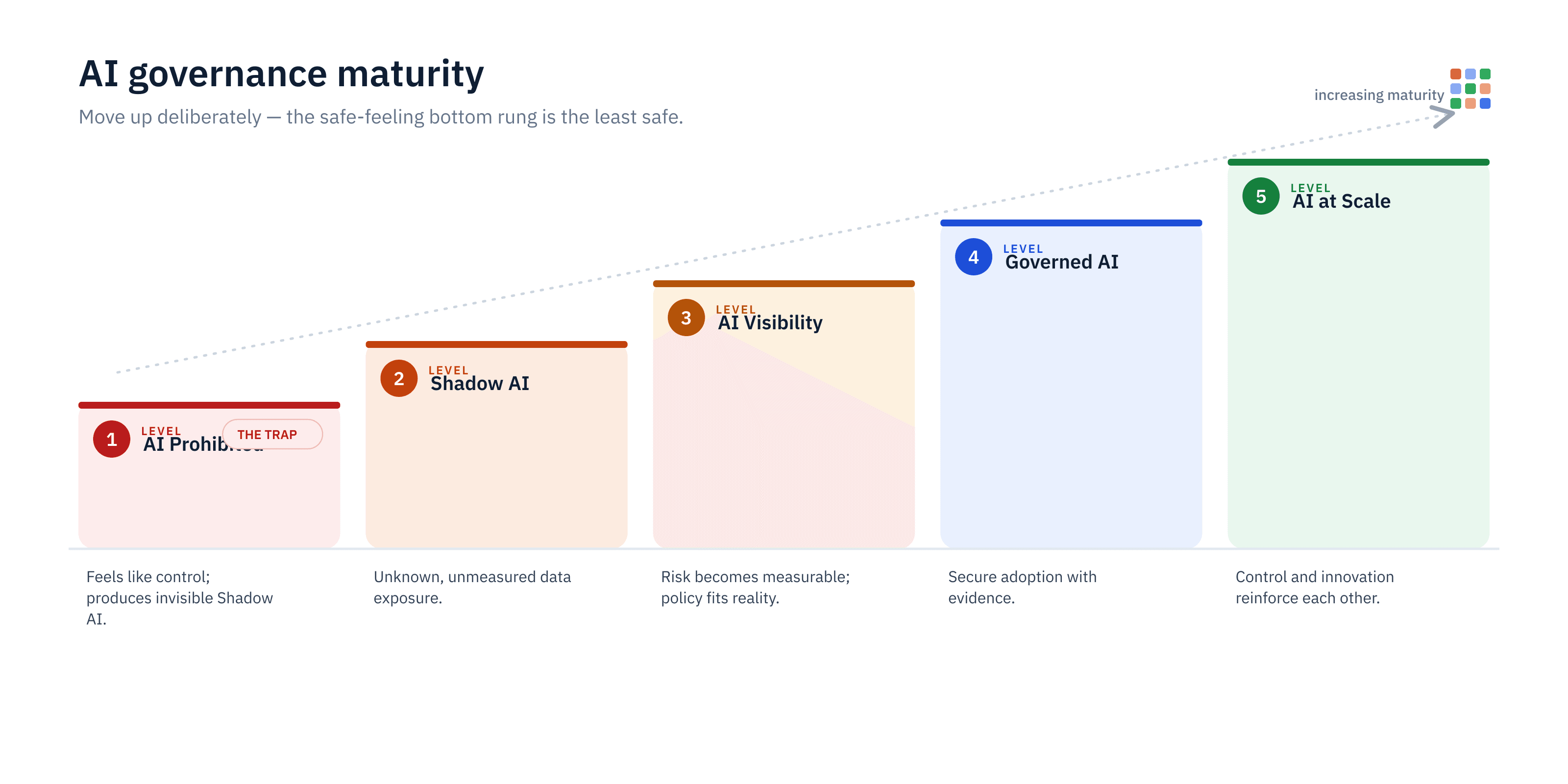
- Level 1: AI Prohibited, AI is banned outright (Shadow AI increases, now fully invisible)
- Level 2: Shadow AI, employees use public AI with no visibility (Unknown, unmeasured data exposure)
- Level 3: AI Visibility, the organization can see who uses AI and how (Risk becomes measurable; policy fits reality)
- Level 4: Governed AI, classify, route, redact, or block at the point of use (Secure adoption with evidence)
- Level 5: AI at Scale, everyday AI, governance runs automatically (Complete evidence; innovation and control reinforce each other)
The trap is Level 1: it feels like control but produces Level 2 in practice. The fastest sustainable route is to reach visibility quickly, then govern.
Recommended Enterprise Architecture
Governing Shadow AI at scale means routing AI interactions through one consistent, governed path so policy is uniform and every decision is provable:
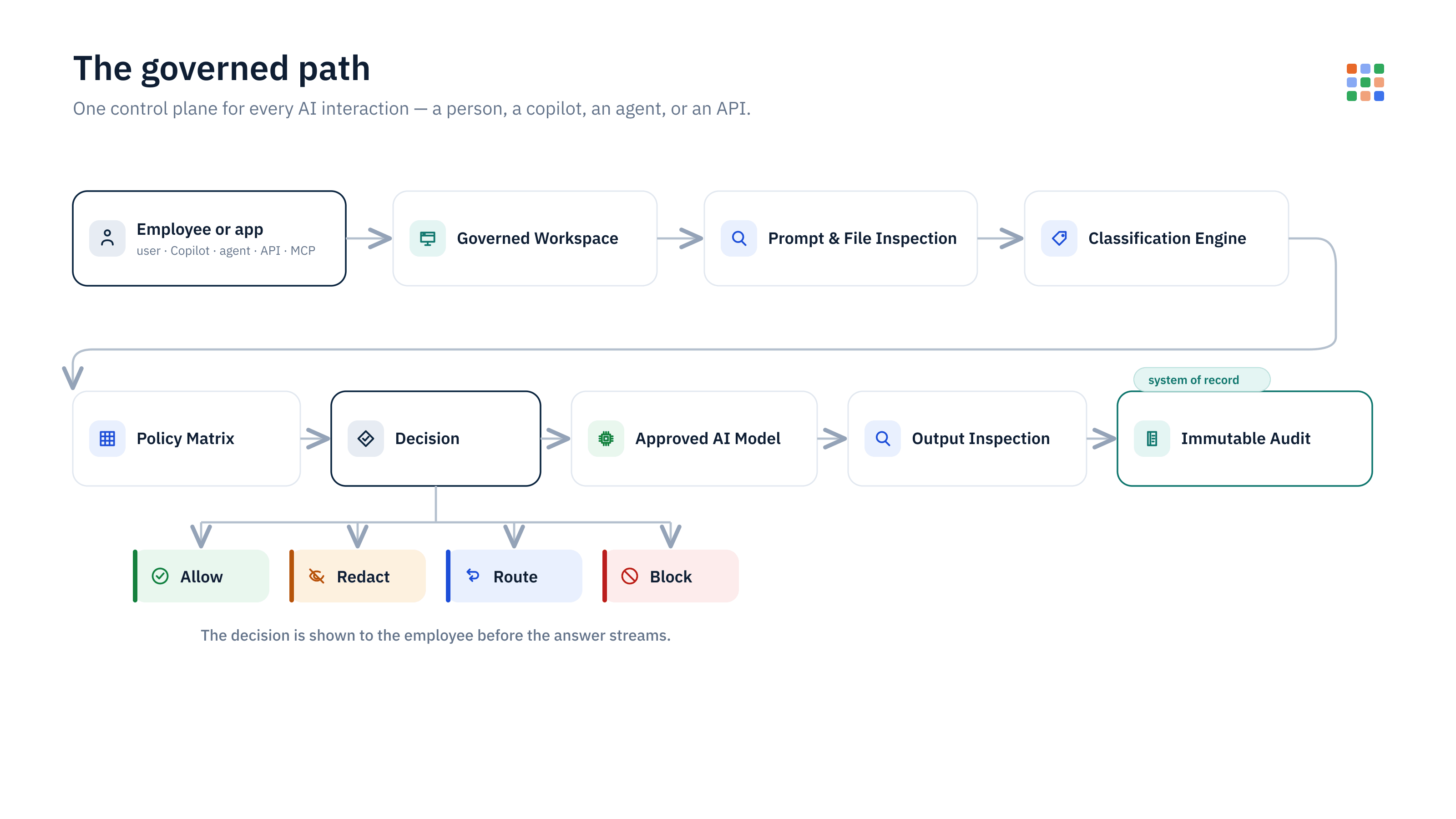
``text Employee or application (user · Copilot · agent · API · MCP) -> Governed AI Workspace -> Prompt & File Inspection -> Classification Engine -> Policy Matrix -> Decision: Allow | Redact | Route | Block -> Approved AI Model -> Immutable Audit ``
The entry point is deliberately "employee or application," because the same governed path should serve more than people typing into a chat box. Over time, Copilot, AI agents, API integrations, and emerging standards like MCP (Model Context Protocol) all become callers of the same control plane, which future-proofs the architecture as AI moves from assistant to autonomous actor.
The business meaning matters more than the boxes. The governed workspace gives employees a sanctioned, capable place to use AI, the fast path that makes the shadow path unnecessary. Inspection and classification move the organization off "trust the employee" and onto enforceable rules that read the actual content of prompts and files. The policy matrix lets the business express risk appetite in its own terms, data classes and approved destinations, rather than in firewall rules. The decision step is where governance becomes enabling rather than obstructive. And the immutable audit turns the whole thing into evidence: if you cannot prove the control ran, from a regulator's perspective it did not.
This is the same governed-path pattern behind AI DLP and broader enterprise AI security; Shadow AI is the problem it most directly solves.
Best Practices
Give people a sanctioned path first. Before you restrict anything, provide a governed AI workspace with approved models that is genuinely fast and useful. Removing the reason for Shadow AI is more effective than fighting the symptom.
Discover before you police. Establish a real baseline of AI usage, including the embedded features you did not know about. Policy written for traffic you have not seen will be wrong.
Classify by data class, not by tool. Define the data classes that matter, PII, payment data, secrets, source code, health data, legal, strategy, and attach governance outcomes to each. The same customer record should get the same treatment whether typed, pasted, or uploaded.
Don't treat all AI models equally. A public frontier chatbot, an enterprise-managed model under contract, a customer-managed tenant, and a private local model carry very different levels of trust. Governance should assign different destinations, trust tiers, and policies to each, and route each data class to the destinations appropriate for it, rather than applying one blanket rule to "AI."
Run monitor mode before enforcement. Observe and log first. Tune classification against false positives, then move to enforcement. Aggressive blocking before tuning creates the frustration that drives people back to shadow tools.
Lead with redaction and routing, not blocking. Reserve hard blocks for the genuinely forbidden. For most sensitive-but-permitted work, redact or route so the task still completes.
Tighten what AI can reach, not just what users type. Reduce the permissions that copilots inherit, and treat AI agents like privileged identities with least-privilege access.
Educate without shaming. Most Shadow AI is well-intentioned. Explain the "why," make the safe path obvious, and treat discovery as a way to help rather than to punish.
Measure and report. Track usage inspected, sensitive items detected, actions taken, false-positive rate, and the share of AI usage flowing through governed versus shadow channels. That last metric is your real scorecard.
Common Mistakes
Banning AI outright. The most common and most self-defeating move, it converts visible risk into invisible risk and forfeits the productivity.
Assuming existing DLP already covers it. Legacy DLP watches files and channels, not prompt semantics. Validate the gap before assuming coverage.
Treating Shadow AI as purely a security problem. It is equally a productivity and enablement problem. A pure-restriction posture guarantees workarounds.
Going straight to enforcement. Blocking before you have visibility and tuned policy produces false positives, complaints, and evasion.
Ignoring embedded and agentic AI. Standalone chatbots are only part of the surface. The AI features inside SaaS and the agents that act on data are easy to miss and often higher-risk.
Weak or absent audit. Without a tamper-evident record, you cannot answer the compliance question the program exists to answer.
Implementation Checklist
- Discover current AI usage, including shadow and embedded AI
- Identify the business functions and data classes most exposed
- Define enterprise data classifications for AI
- Stand up a governed AI workspace with approved models
- Establish trust tiers for AI destinations (public, enterprise-managed, customer-managed, private)
- Write a policy matrix: per data class, decide allow / redact / route / block / approve
- Deploy inspection of prompts, files, and responses
- Run in monitor mode to baseline and tune classification
- Enable immutable audit logging and connect it to your SIEM
- Move to enforcement gradually, starting with the highest-risk rules
- Communicate the sanctioned path and educate employees
- Review metrics and extend coverage as new AI tools appear
Frequently Asked Questions
What is Shadow AI in simple terms? Shadow AI is employees using AI tools for work without the organization's approval, visibility, or governance, for example, pasting company data into a public chatbot or a personal AI account.
How is Shadow AI different from Shadow IT? Shadow IT is unapproved software and cloud services, mostly about where data is stored. Shadow AI is about what employees say to a model, freeform prompts and uploaded documents that can carry far more sensitive context than a stored file.
Why is Shadow AI increasing? Capable AI tools are free, instant, and everywhere, enterprise AI adoption is already mainstream, and most organizations have not provided a governed path that is as fast as the public tools. Where the approved option is slower or absent, employees use the shadow one.
Is Shadow AI always a policy violation? Not necessarily. Sometimes it breaches an explicit rule; often it is simply usage no one anticipated or governed. Either way, the risk is the same: sensitive data moving with no classification, decision, or record.
What are the biggest risks of Shadow AI? Sensitive data exposure and IP loss, no visibility or detection, inbound oversharing from permission-inheriting copilots, prompt injection against AI assistants, an expanded third-party attack surface, and the inability to demonstrate compliance.
Can we just block ChatGPT and be done? No. Blocking one tool pushes usage to personal devices, personal accounts, and the AI features embedded in SaaS you cannot block without breaking the tool. It hides the problem rather than solving it.
How do we detect Shadow AI? Combine network/proxy and CASB telemetry, identity and OAuth signals, endpoint and browser signals, a review of embedded SaaS/Microsoft 365 AI features, and direct conversations with employees.
How does Shadow AI relate to Microsoft Copilot? Copilot answers from what a user can already access, so over-shared content can surface in answers. Governing it means tightening the underlying permissions and sensitivity labels it relies on and adding visibility and audit evidence over how it is used.
Is Microsoft Copilot considered Shadow AI? Not when it is deployed and governed through your managed tenant with the right controls. Copilot becomes Shadow AI when it is used outside governance, through unmanaged tenants or personal accounts, or without controls over the data it can access and surface. The test is never the brand name; it is whether the usage is visible, policy-controlled, and audited.
Does AI DLP solve Shadow AI? AI DLP is the enforcement layer that inspects prompts and files and applies allow/redact/route/block decisions. It is central to governing Shadow AI, alongside discovery and a sanctioned workspace.
What is the difference between monitor mode and enforce mode? Monitor mode observes and logs without blocking, so you can baseline usage and tune classification. Enforce mode applies the decisions. Always monitor first.
Won't governance slow employees down? Done well, no. Most requests are allowed or automatically redacted/routed; only a few classes are blocked. The aim is to remove the reason to use shadow tools, not to add friction.
Which regulations apply to Shadow AI? Existing data-protection and sector rules (such as GDPR, PCI DSS, HIPAA, and financial-sector rules) still apply to data that flows into AI, and the EU AI Act adds AI-specific obligations. Shadow AI mainly removes your ability to prove compliance.
What is the first step to getting Shadow AI under control? Discovery. Find out which AI tools your organization actually uses and where sensitive data flows today, then stand up a governed path and move from monitor to enforce.
Key Takeaways
Shadow AI is the unsanctioned, invisible, ungoverned use of AI inside an organization. It exists because the tools are useful and instant while the governed path is usually slower or missing, and because employees are trying to be productive, not to evade security.
The risks span business (IP and confidentiality loss, unaccountable decisions), security (data exposure, no detection, inbound oversharing, prompt injection), and compliance (existing obligations still apply, but you can no longer prove enforcement). Traditional controls miss it because they watch files and channels, not conversations with a model.
The answer is not prohibition, which hides the problem, but governance: discover usage, provide a sanctioned path, classify by data class, route to approved destinations, redact where possible, block only the clearly forbidden, inspect outputs, and audit every decision. Make the approved path easier than the shadow path, and the shadow path fades.
Conclusion
Shadow AI is not a sign that your employees are careless or adversarial. It is a sign that AI is useful and that your governed path is not yet as fast as the free one. That is a solvable problem, and solving it does not require slowing anyone down.
Start with visibility. Map which AI tools are actually in use and where sensitive data flows today. Define the two or three data classes you most need to protect, stand up a governed workspace with approved destinations, and run inspection in monitor mode before you enforce. The findings will show you exactly where the exposure is, and they will make the case for the rest of the program.
The organizations that succeed with AI won't be the ones that ban it. They'll be the ones that make governed AI the easiest way to work.
Where ThreatLens Fits
ThreatLens Governance is the enterprise AI control plane for secure AI adoption, one way to operationalize everything above. Instead of trying to ban AI, it gives employees a governed AI workspace and places a single control point in the path of AI interactions, so Shadow AI has somewhere sanctioned to go and security has consistent visibility and control.
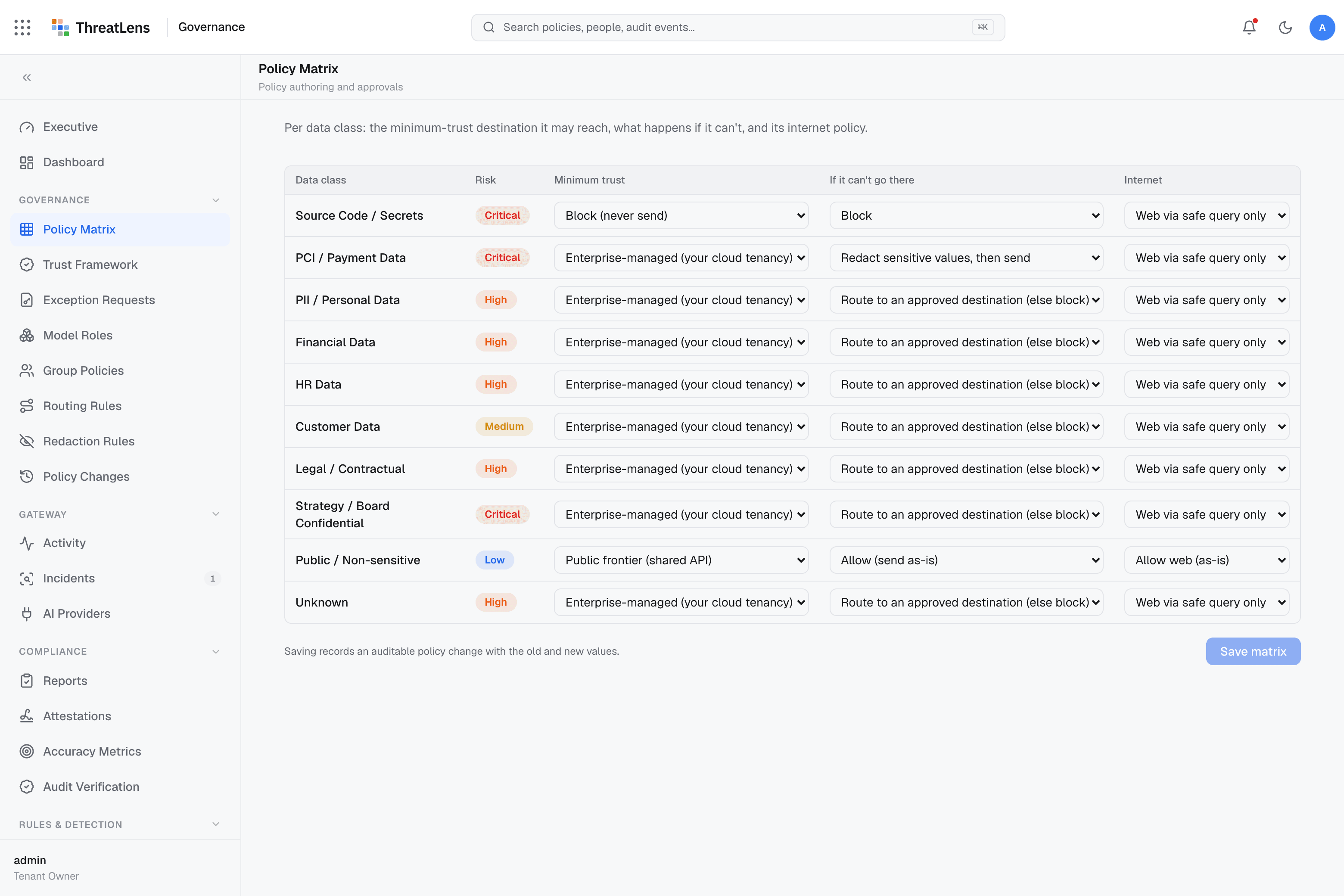
!The ThreatLens policy matrix: per data class, the minimum-trust destination, the fallback action, and the internet policy. The [ThreatLens policy matrix](https://docs.thethreatlens.com/docs/concepts/policy-matrix), set, per data class, the minimum-trust destination, the action if it can't go there, and the internet policy.

In practice, ThreatLens governs AI adoption by classifying prompts and files in real time, applying a policy and trust matrix, and taking a graduated decision at the point of use: allow low-risk work, redact sensitive values, route sensitive-but-permitted requests to an approved model — Azure OpenAI, AWS Bedrock, or a private model — or block prohibited requests. Employees see the governance decision before the answer. Every decision lands in a tamper-evident audit record you can hand to an auditor.
The design reflects the core lesson of Shadow AI: enable and govern most AI usage, and block only what is clearly forbidden. Because the governed path is fast and capable, employees have no reason to route around it, which is what actually shrinks Shadow AI. ThreatLens supports a monitor-to-enforce rollout, so you can baseline real usage and tune policy before enforcing. Learn more at thethreatlens.com.
Related Reading
What Is AI Governance? · What Is AI DLP? · Enterprise AI Security Best Practices · What Is an AI Gateway? · AI Governance for Microsoft Copilot · How to Prevent ChatGPT Data Leakage · Secure RAG · AI Governance for Financial Services · AI Governance for Healthcare · AI Governance Framework · AI Governance Maturity Model · AI Policy Matrix.